
 MentorX
 1
Chen Guangyu replied that he was preparing to head to the Bay Area. When someone then asked whether he planned to join Anthropic, he said no.
Recently, 17-year-old Chen Guangyu posted on X to announce his departure from Kimi. His note was brief — he gave no reason for leaving and did not reveal his next destination.
What drew widespread attention was that Anthropic researcher Sholto Douglas commented on the post. He mentioned they had met the previous week, then asked whether Chen still planned to attend Carnegie Mellon University, and invited him to come to San Francisco to work with teams including Prime and Base10.
Chen Guangyu replied that he was getting ready to head to the Bay Area. When someone subsequently asked if he intended to join Anthropic, he said no.
Chen has attracted attention for more than just his age.
Back in March 2026, while still in the 12th grade, he was a co-first author with equal contributions on the Kimi team’s paper *Attention Residuals*, listed alongside Zhang Yu and Su Jianlin. He joined Kimi at 16 and has worked on foundational research such as large-model architectures.
When addressed with the “child prodigy” label, he once responded that he hoped people would focus less on him personally and more on the technology and the team. The research he has already completed may better explain why peers in the field are taking notice — far more than the number “17”.
In the United States, competition for young talent has long kicked off well before college graduation.
01 Some Receive Multiple Offers at 16; Others Choose Between Ivy League Schools and Corporate Roles at 18
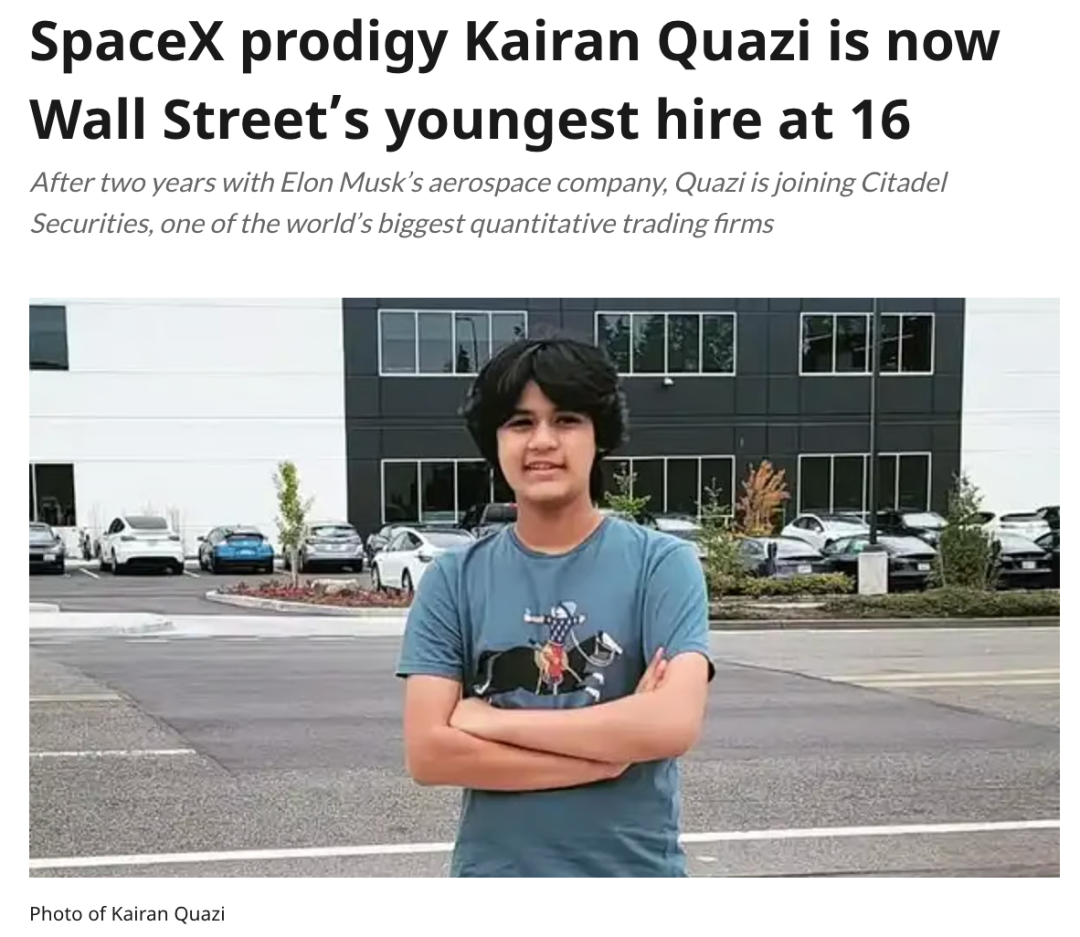
In August 2025, 16-year-old Kairan Quazi left SpaceX to join Citadel Securities as a quantitative developer.
At that age, he already had two years of professional experience. In 2023, 14-year-old Quazi graduated from Santa Clara University and then joined SpaceX’s Starlink team as a software engineer.
According to Business Insider, AI labs and major tech firms also extended offers to him during this career move. He ultimately picked Citadel Securities, drawn to fresh technical challenges and the fast feedback loops common in quantitative finance.
The report did not name the other offering companies, but at 16, he was already a sought-after candidate across different types of employers.
Another young talent, Matteo Zanini, faced a choice between university admission and a corporate program.
At 18, he nearly simultaneously got accepted to Brown University and was selected for Palantir’s Meritocracy Fellowship. Since Brown does not allow deferred enrollment, he chose Palantir.
The program targets high school graduates, with its first cohort consisting of 22 participants. Fellows go through training before joining internal teams to work on real projects; strong performers after four months may be offered full-time roles.
The Wall Street Journal reported that Zanini was drawn to the genuine projects and real responsibilities the company entrusted to young people. At the time of the report, it remained unclear whether he would receive a full-time offer.
One candidate with proven engineering experience received multiple competing offers; another entered a company straight out of high school through a dedicated talent track. Their paths differ, yet both illustrate that some companies now identify, evaluate and nurture talent long before commencement.
02 Companies No Longer Wait Until Graduation to Recruit
Students often picture job hunting as an activity reserved for the later college years: take classes, pick a major, hunt for internships in junior year, and apply for full-time roles before graduation.
But companies follow their own recruiting timelines. Some hire capable young candidates directly; others assess potential through structured development programs; many open internship applications more than a year in advance.
In September 2026, The Alligator interviewed University of Florida student Daniel Khani. He settled on investment banking as his track in freshman year and began networking with banking professionals. In the spring of his sophomore year, he landed a junior summer internship at Goldman Sachs and earned a return offer after completing it.
In the same piece, the school’s finance career director noted that interviews for junior summer internships are increasingly held in the fall of sophomore year. Some students enter the recruiting pipeline before they have even taken finance courses.
This matters more for ordinary international students than the prodigy stories.
You may be targeting a junior summer internship, yet firms can start screening candidates when you are still a sophomore. If you prepare only around the internship start date, many applications will already be closed by the time you update your resume and build projects.
Internships frequently translate into full-time jobs after graduation. As the first step of recruiting moves earlier, your preparation timeline must shift accordingly.
03 International Students: Plan Ahead and First Map Out Recruiting Schedules
A practical first step for regular students: find out exactly when your target roles open for applications.
Application windows, interviews and internship start dates fall on separate timelines. If you are interested in an industry, review recent hiring cycles at your target firms and back-plan resume work, project building and interview prep. Timelines vary widely; the IB schedule cannot be copied directly onto tech or other sectors.
Underclassmen do not need to lock in a career path immediately. Course projects, research, club work and short career events can expose you to real work and help you gauge your interests and fit.
These experiences also build your application portfolio. You need to reflect clearly on what you delivered in each project, what problems arose and how you resolved them. You can polish your writing close to deadlines, but substantial hands-on experience cannot be fabricated last minute.
International students should also verify eligibility rules alongside opportunity research. Confirm with recruiters and your school which students qualify for a program, whether work authorization is required, and if sponsorship will be available down the line.
04 Early-Career Programs for Underclassmen Are Not Always Formal Internships
Company programs for younger students are not limited to traditional internships. Short industry immersions, workshops and employee panels can help you explore roles and decide how to prepare next.
For example, Goldman Sachs’ Possibilities Series targets first-year undergraduates across US universities, introducing financial services through workshops and networking sessions. The 2026 spring cohort listed on its site is closed for applications; treat it as an example of programs to watch for future cycles rather than an active opening.
Jane Street’s First Year Trading and Technology Program (FTTP) is also built for college freshmen, combining coursework and simulated group trading exercises. Its materials state that prior finance knowledge is not required; STEM students majoring in math or computer science can learn about trading and technical roles. The website currently lets users sign up for alerts for future sessions, with exact schedules pending updates.
The value of these programs lies in early industry exposure. Attending an event does not equal an internship offer, much less a full-time job. Still, seeing real business workflows and hearing from practitioners makes it easier to decide whether you want to keep investing in that field.
Upperclassmen should not assume it is too late if they miss a certain program. First check which opportunities are still live, then prioritize your most urgent preparation tasks.
It is easy to fixate on where Chen Guangyu will go next after his departure post. For students studying in the US, there is a far more relevant question to answer: when does recruiting open for the internship you want to apply for next?