
 MentorX
 95
95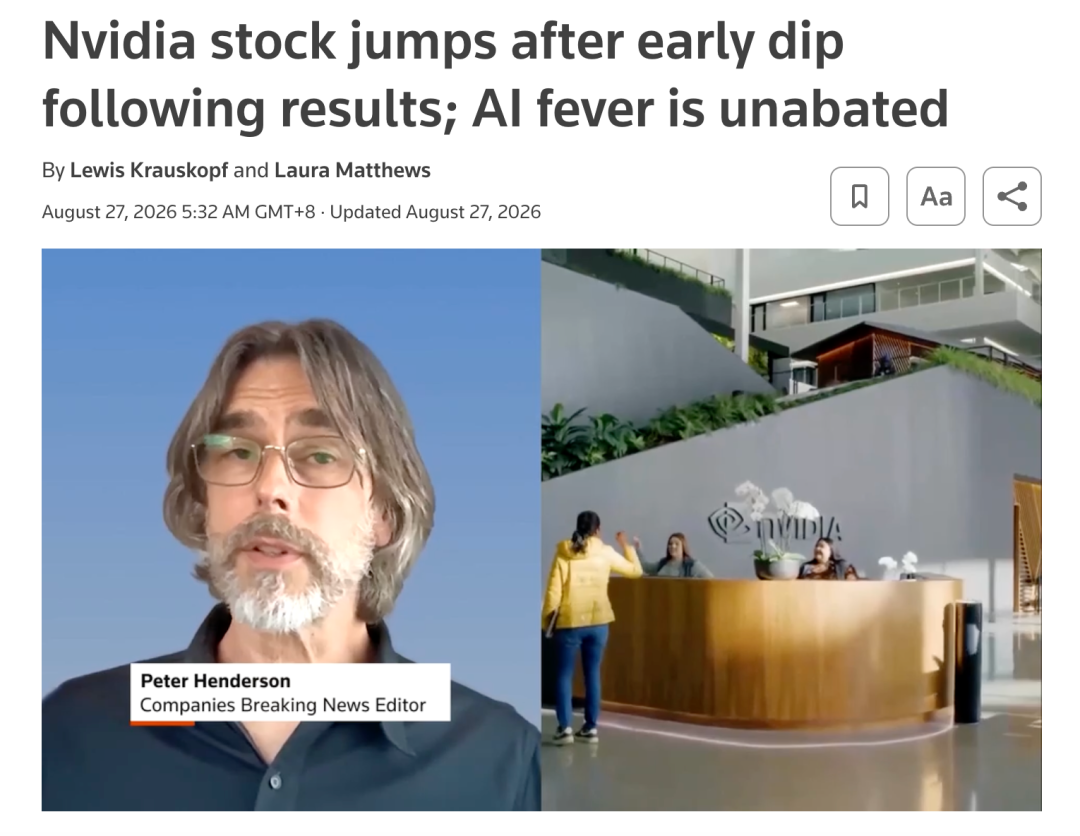
AI can write code now, and Junior SWE roles are shrinking. Companies leverage AI to boost workforce efficiency, continuously squeezing entry-level headcount. A team that once needed ten people may now operate with only six… Consequently, many international students grow anxious: if AI keeps advancing, will we still be able to land jobs?
Over the past two years, whenever AI and employment are discussed, international students rarely hear encouraging news.
AI can write code now, and Junior SWE roles are shrinking. Companies leverage AI to boost workforce efficiency, continuously squeezing entry-level headcount. A team that once needed ten people may now operate with only six…
Consequently, many international students grow anxious: if AI keeps advancing, will we still be able to land jobs?
Yet newly released figures from NVIDIA reveal another side of the AI job market.
On August 26, NVIDIA published its FY2027 Q2 earnings report: quarterly revenue hit $96.2 billion, a 106% year-over-year increase. Data Center revenue reached $89 billion, up 117% year over year.
In other words, more than 90% of NVIDIA’s current revenue now comes from its Data Center business.
Jensen Huang stated directly in the earnings call: “The AI infrastructure buildout is at full steam.” Construction of AI infrastructure is advancing at full speed.
What matters more to international students is that this AI race is no longer merely a competition to build the most powerful models. It has evolved into a massive contest to build infrastructure.
Beneath this trend lie potentially one of the biggest structural shifts in North America’s job market in the coming years.
01 Jensen Huang’s Latest Remarks: AI Competition Has Entered the “Infrastructure Era”
Over the last two years, most people’s understanding of the AI industry stopped at: ChatGPT went viral, so AI Engineers are in high demand; AI requires GPUs, so NVIDIA boomed.
But the real AI industrial chain is far more complex.
For a model to serve hundreds of millions of users reliably, it needs not only algorithms and GPUs but an entire sprawling infrastructure stack: Chips → Servers → Networks → Data Centers → Power → Cooling → Construction → Supply Chain → Finance → Operations.
This industrial chain is expanding rapidly, and NVIDIA’s latest earnings report serves as an intuitive signal.
In FY2027 Q2, NVIDIA’s Data Center revenue reached $89 billion, rising 117% year over year. Meanwhile, its Vera Rubin platform has entered mass production and is being deployed with partners including CoreWeave, Google Cloud, Microsoft Azure and Oracle Cloud Infrastructure.
Reuters also reported that global spending on AI infrastructure industries is projected to exceed $730 billion this year.
But a critical question arises: Where will all these GPUs be housed? The answer is data centers.
Once data centers are built, new challenges emerge: Where will the power come from? How will servers be cooled? How do tens of thousands of GPUs interconnect? Where is equipment sourced? Who builds the campus? Who finances billion-dollar projects?
AI’s impact thus extends outward from tech firms into the physical world.
Jensen Huang touched on this topic again in a recent interview. He argued that data center construction is not just an AI industry issue; it may also drive U.S. reindustrialization and upgrades to energy infrastructure.
Therefore, simplifying “AI job hunting” to “CS students become AI Engineers” is outdated.
A more accurate framing: AI is gradually forming a vast industrial ecosystem spanning technology, semiconductors, energy, manufacturing, construction, finance and supply chains.
That is why we believe people who capture AI employment dividends in the next few years may not even have “AI” in their job titles.
02 AI Is Displacing Jobs, While Creating New Roles Elsewhere
This is perhaps the greatest contradiction within today’s AI job market.
On one hand, AI is reshaping many traditional entry-level roles.
Basic coding, data wrangling, research, copywriting, simple financial analysis… More tasks previously assigned to junior staff can now be handled by AI.
On the other hand, as corporations invest hundreds of billions into building AI infrastructure, massive numbers of specialized real-world professionals will be required — and these opportunities are open to far more than just CS majors.
Category 1: Software / Data**
Software Engineers remain essential in the AI era, yet demand structures keep shifting.
Compared with generic SWE roles, high-potential tracks to watch include: AI Infrastructure, ML Systems, Distributed Systems, Cloud Infrastructure, Data Engineer, MLOps, Network Infrastructure.
Especially for international students with CS, DS, Statistics or Analytics backgrounds, you do not have to compete exclusively for popular ML Engineer openings.
Take data roles as an example: The more AI models deployed, the higher the requirements for data pipelines, data infrastructure, storage and data quality.
In some cases, Data Engineer positions may hold greater value than Data Scientist roles.
Category 2: Semiconductor / Hardware / Engineering**
AI cannot live solely in software. Models run on GPUs; GPUs are installed in servers; servers require power, networking and thermal management.
The entire hardware industrial chain is pulled into this wave, including ASIC, Verification, Physical Design, Hardware Validation, Packaging, Power Systems, Electrical Engineering, Thermal/Cooling and Critical Facilities.
This is where EE, ECE, CE and ME majors can capture AI dividends. Even roles that previously drew little attention from international students, such as cooling engineering, deserve renewed consideration.
As power consumption per AI rack surges, cooling is no longer simply a matter of adding extra fans. Technologies like liquid cooling are growing increasingly critical.
Everyone chases model breakthroughs, yet few notice: The more powerful GPUs become, the more critical power supply and cooling grow.
Category 3: Supply Chain / Operations**
These opportunities are not limited to STEM students. AI data centers demand GPUs, servers, optical modules, switches, power gear, cooling hardware and countless other components.
None of these materials materialize inside data centers by themselves.
Supporting roles include Supply Chain Analyst, Procurement, Strategic Sourcing, Operations, Capacity Planning and Program Manager.
NVIDIA is rapidly scaling its supply chain commitments. Recent reports state the company is locking in key components and chip production capacity in advance via massive long-term supply agreements.
International students majoring in Supply Chain, Business Analytics, Industrial Engineering and Operations are fully capable of finding relevant positions.
Category 4: Finance / Business**
Another often-overlooked dimension: capital. Large-scale AI data center projects involve enormous capital expenditure.
Who conducts investment analysis? Who arranges financing? Who calculates ROI? Who builds budgets? Who assesses risks?
Expanding AI infrastructure also creates roles in Project Finance, Infrastructure Investment, FP&A, Corporate Strategy, Risk and Business Operations.
Finance students do not need to rush to learn machine learning just because AI is trending.
What you truly need to identify is the intersection between your major and the AI industrial chain.
Power supply is no longer just post-construction maintenance; it is a core factor determining whether a data center can be built, when it goes live, and its long-run operating costs.
That explains why tech firms are competing fiercely for power industry talent.
03 Why International Students Should Pay Early Attention to This Wave of Opportunities
For one thing, North American job hunting is extremely saturated right now. International students converge heavily on the same target roles: CS students apply for SDE/DS roles; business students target consulting and IB; financial math students chase Quant positions. Candidates with similar degrees, similar projects and identical LeetCode preparation compete for the same pool of entry-level openings.
But if you broaden your scope beyond popular jobs to the full AI industrial chain, options multiply dramatically.
CS students can explore AI Infrastructure; EE students can look at semiconductors, power systems and data centers; ME students can focus on cooling; IE students can pursue operations and capacity planning; Supply Chain candidates can target procurement and sourcing; Finance students can explore infrastructure finance; Business students can look at strategy and program management.
Not everyone needs to pivot into AI. The right approach is to locate where your expertise fits within the AI industrial chain.
A second notable shift is geographic distribution.
Traditionally, international students looking for tech jobs default to the Bay Area, Seattle and New York. Yet data centers, semiconductors, energy and advanced manufacturing do not all have to be built in Silicon Valley.
This means job seekers can actively explore markets in Texas, Virginia, Ohio, Arizona, Pennsylvania and beyond.
For international students, this creates a new information edge: while others fight over generic SWE roles in the Bay Area, you can pursue faster-growing AI infrastructure positions in secondary markets.
In today’s job market, expanding your list of target companies and locations directly unlocks more opportunities.
04 How Class of 27 New Grads / 27 Summer Interns Should Strategize Now
The core question is not: “Should I switch into AI?”
On the contrary, we strongly discourage blind mass pivots toward AI just because it is trendy.
The first priority is changing how you search for jobs. Previously, many students practiced major-based job search: “I study CS, so I search Software Engineer; I study Finance, so I search Financial Analyst; I study EE, so I search Electrical Engineer.”
Going forward, try industry-chain-based job search.
First identify a growing industry, then follow upstream and downstream links in its supply chain to locate roles matching your background.
Take AI Infrastructure as an example: Cloud → Chip → Server → Networking → Data Center → Power → Cooling → Construction → Supply Chain → Finance.
Then ask yourself: “Which segment can my background access?”
Second, rebuild your target company list.
Do not limit it only to Google, Meta, NVIDIA and Microsoft. The complete AI industrial chain includes many firms across semiconductors, networking, data center operators, utilities, energy, cooling engineering, construction and supply chains.
Third, revise your resume.
The focus is not stuffing keywords like “AI”, “LLM” or “Machine Learning” onto your resume. Recruiters want to see how your experience solves real industry problems. If you have FPGA experience, target AI hardware roles; with supply chain experience, look into AI server supply chains; with power system work, pursue data center power roles; with financial modeling experience, explore infrastructure finance. This is far more effective than building a generic LLM project like every other candidate.
Lastly, timing matters.
For international students preparing for 27NG and 27 Summer roles, your biggest advantage is not knowing one “dream job”. It is spotting where recruitment trends are shifting earlier than others.
Once a field becomes widely discussed across Xiaohongshu, LinkedIn and Reddit, the information advantage vanishes.
The true information edge in the AI job market belongs to those who understand the full industrial chain early and lock in their niche ahead of time.
For international students, the biggest risk in North American recruitment is not fierce competition — it is spamming hundreds of applications while chasing the wrong career direction.
The recruitment window for 27NG and 27 Summer is already opening. When sending out 100 applications, some candidates keep sending low-match generic resumes, while others break down target roles by industry, company and team, aligned with their academic background, immigration status and hiring trends.
Vine Education is currently supporting 27NG / 27 Summer students with fall recruitment planning.
We will not simply tell every student “AI is hot, so switch to AI”. Instead, we map target roles and target company lists tailored to each student’s major, university, past internships, projects, preferred work locations and OPT/H-1B immigration status.
We plan the entire fall recruitment timeline in advance: career positioning, resume refinement, job filtering, networking, technical interviews, behavioral interviews and final offer evaluation.
If you are unsure whether to aim for SDE, Data or AI Infrastructure, or expand into semiconductors, finance, supply chain and other tracks — rather than discovering misalignment halfway through fall recruitment, lock your job search roadmap early while headcount continues to roll out.