
 MentorX
 92
92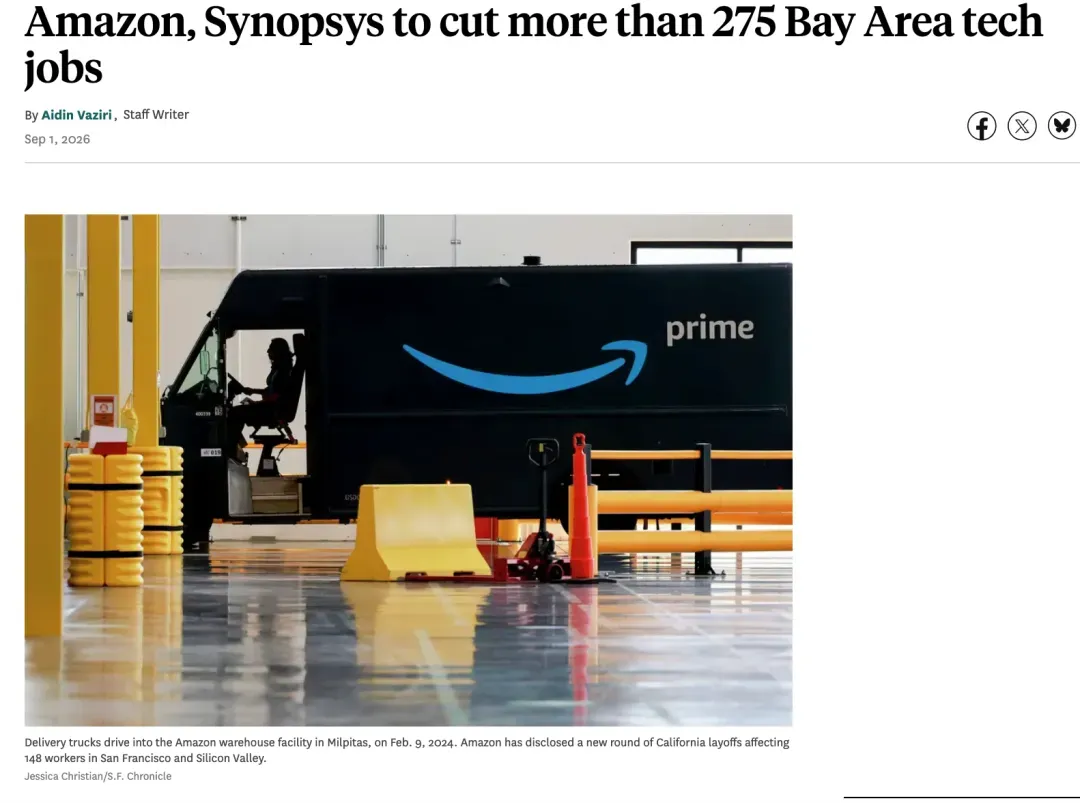
On September 1 local time, Amazon filed layoff notices with California’s employment regulator. It will cut 78 roles in San Francisco and 70 roles in Sunnyvale, totaling 148 positions. The terminations are expected to take effect in phases starting October 20.
On September 1 local time, Amazon filed layoff notices with California’s employment regulator. It will cut 78 roles in San Francisco and 70 roles in Sunnyvale, totaling 148 positions. The terminations are expected to take effect in phases starting October 20.
If judged solely by headcount, this may look like just another minor internal reshuffle at Amazon.
But the picture shifts once you look at the layoff list.
Among the 78 roles in Amazon’s downtown San Francisco office, 76 employees are listed as Members of Technical Staff. The cuts also include Software Development Engineers and a Senior Manager of UX Design.
The Sunnyvale roster is even more straightforward: Software Development Engineers, Applied Scientists, Data Scientists, QA Engineers, Technical Program Managers — all are on the list.
This round of layoffs has clearly hit roles familiar to CS and DS international students, positions many once viewed as relatively safe havens.
01 Amazon Layoffs: Software and Data Roles Are No Longer Safe Zones
When tech layoffs made headlines in the past, many international students’ first thought was recruiting, HR or middle management.
It was easy to assume that as long as you majored in CS or Data Science and stayed on a technical track, you would be insulated from cuts. Amazon’s newly disclosed notices shatter that assumption.
This Bay Area layoff round includes not only Software Development Engineers but also Applied Scientists and Data Scientists. That means the impact extends beyond support and management roles. Staff directly involved in software development, data analytics and algorithmic research are also vulnerable to organizational restructuring.
A technical job title alone no longer guarantees job security. Moreover, this is not Amazon’s only recent restructuring.
In January 2026, Amazon announced roughly 16,000 corporate job cuts globally. Back in October 2025, the company had already eliminated around 14,000 roles. Combined, the two rounds removed approximately 30,000 positions.
02 Cutting SWEs While Hiring for AI: What Is Amazon Doing?
Shortly after news of the Bay Area layoffs broke, multiple generative AI openings remained live on Amazon Jobs.
For instance, the Project Dawn team is recruiting Software Development Engineers to build generative AI solutions for Amazon App, web portal, Alexa, Rufus and other products.
Amazon Selection and Catalog Systems is also seeking GenAI/ML-focused SDEs to work on LLMs, multimodal models and product catalog classification systems.
Elsewhere, Prime Video continues hiring Applied Scientists for generative AI work. The product catalog team is looking for scientists with expertise in vision-language models and multimodal reasoning.
Within the same company, SWEs, Applied Scientists and Data Scientists are being laid off even as the firm recruits for those exact same job titles.
Amazon is not slashing all technical roles or eliminating its need for engineers. Instead, it is reallocating budgets and headcount across different business units, projects and teams.
In its earlier, broader organizational overhaul, Amazon stated it aimed to flatten management layers, clarify accountability, trim bureaucratic processes and redirect resources toward higher-priority strategic areas. The firm also noted it would keep hiring for critical businesses and functions.
So what is really happening is not “all technical jobs are disappearing.” Enterprises are simply applying stricter scrutiny to these questions:
- Is this team still strategically important?
- Is this project worth continued investment?
- Does the value created by this role align with the company’s next-phase strategy?
03 The Company Is Still Hiring — That Does Not Mean Your Opportunity Exists
When preparing for US job hunts in the past, many students started by evaluating companies at a high level:
- Is Amazon hiring this year?
- Is Google under a hiring freeze?
- Does Meta still have New Grad openings?
Today, judging only by company-wide hiring status can lead to misleading conclusions.
Amazon is certainly still hiring. But “Amazon is hiring” does not mean every business unit is expanding. The presence of live SWE postings on its career page does not guarantee stable headcount for every software team.
Two roles both titled Software Development Engineer can have vastly different budget priorities, depending on whether you are maintaining internal legacy systems, building cloud infrastructure, or developing AI Agents.
Likewise, data roles vary widely. A position focused on routine dashboards, experiment analysis, training data pipelines or multimodal modeling will carry very different capability expectations from employers.
Pivoting toward AI is also far more than dropping keywords like “LLM” and “Agent” on your resume. Companies do not want candidates who merely dabbled in AI projects. They want people who can use technology to solve real-world problems.
04 Stop Chasing Big Tech Logos — Track Team-Level Headcount
The clearest takeaway from Amazon’s layoffs for international students is neither “CS is useless” nor “everyone must switch to AI.”
What truly needs to change is how you evaluate opportunities.
When building your application list, do not only log the company, job title and application link. Add these extra details:
- Which team and business vertical the role sits under
- Posting date and current hiring status
- Whether it is a new opening or a backfill
- Core tech stack and actual day-to-day responsibilities
- Whether it sits within the company’s key investment areas
- Whether interviews have already kicked off
- Confirmation from the job page or recruiter about visa sponsorship
During networking, avoid generic questions such as “Is your company hiring right now?”
More effective questions include: Does your team still have headcount this year? What type of candidates are you actively recruiting? What is the most urgent problem this role needs to solve?
Your application portfolio should also be diversified. Beyond FAANG firms, look at AI-native startups, mid-sized tech companies, plus technical teams within traditional industries including finance, healthcare and retail. Students relying on OPT, STEM OPT or H-1B also need to weigh role stability, immigration timelines and backup opportunities side by side.
Tech hiring in the US has not halted, but opportunities are becoming increasingly granular. Moving forward, the meaningful question is no longer: “Is this company hiring?”
Instead, ask: Why is this role still open now? Why does this team still receive headcount funding? And why should the company keep investing in my skill set?