
 MentorX
 71
71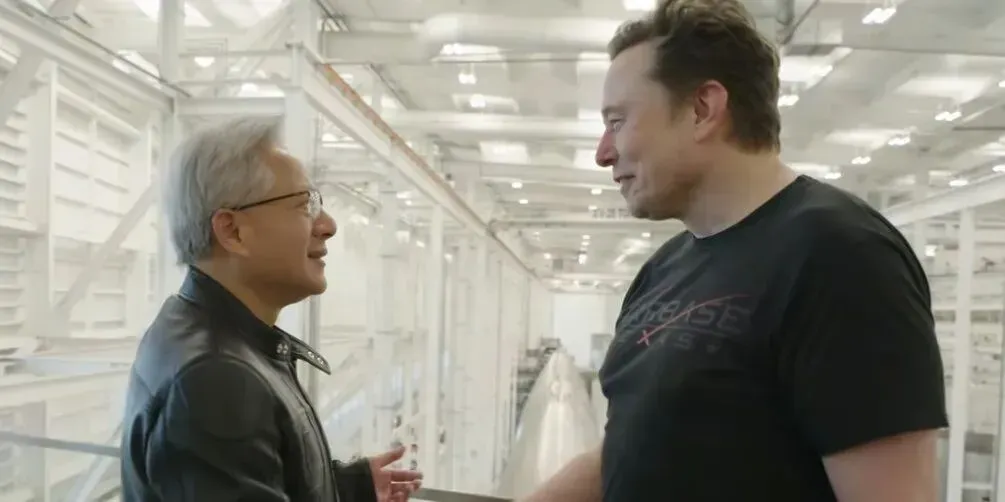
SpaceX will partner with NVIDIA to develop Starmind, a space-based supercomputing system. The detailed plan is quintessentially Musk-esque. The two parties intend to launch one million AI compute satellites equipped with NVIDIA Rubin and Vera CPUs into space, building a data-center-scale supercomputing network directly in orbit.
A bombshell has dropped in the tech world: Elon Musk and Jensen Huang are joining forces.
SpaceX will partner with NVIDIA to develop Starmind, a space-based supercomputing system. The plan is quintessentially Musk. They intend to launch one million AI compute satellites equipped with NVIDIA Rubin and Vera CPUs into space, building a full data-center-scale supercomputing network directly in orbit.
The two tech titans have even exchanged mutual praise:
👉🏻 Elon Musk: NVIDIA’s GPUs are the best there are.
👉🏻 NVIDIA: The next chapter of AI infrastructure will boldly venture into places no one has gone before.
Back in China, Hangzhou’s Zhejiang Lab and Chengdu’s Guoxing Aerospace are also actively advancing the "Trisolaris Computing Constellation" and "Star Computing Project." Some may ask: Are data centers outgrowing Earth, that they have to be moved into space? The answer is yes.
01 Why Move Computing Power into Space?
Earth-based AI data centers are currently trapped by three crippling bottlenecks: massive land occupation, staggering power consumption, and enormous cooling water usage.
👉🏻 Water resource depletion: One Google data center in Iowa consumes 5.3 million tons of cooling water every year.
👉🏻 Power crisis: Data centers are voracious energy consumers and have sparked public backlash across many parts of the US. Due to strains on water and power supplies, the Governor of New York even halted construction of hyperscale data centers statewide.
In space, however, energy is nearly unlimited — solar power generation is 7 to 10 times more efficient than on Earth, unaffected by surface weather conditions.
Shifting computing infrastructure from the ground to space sounds like science fiction. But dismissing this news as nothing more than Musk and Huang selling pipe dreams means completely missing the bigger picture.
For international students and job seekers in North America, this sends an extremely powerful signal:
The advancement of AI is far more than just "training a model." It is about rebuilding an entire massive AI infrastructure ecosystem.
02 Job Hunting in North America Through the Lens of Space Computing: What Is the Market Actually Hiring For?
As the industry shifts its focus from competing on model algorithms to rebuilding infrastructure, North America’s recruitment market is undergoing a quiet yet dramatic reshuffle.
Breaking down the industrial chain of this AI infrastructure upgrade reveals how job requirements have fundamentally changed:
1️⃣ Surging demand for computing power → Semiconductor / Hardware / EE / ECE
If data centers are heading to space, chips and hardware are the primary drivers. Professionals capable of designing high-performance ASICs, understanding chip architecture, and specializing in hardware engineering and electrical & computer engineering (EE/ECE) are highly sought after by top tech giants.
2️⃣ Large-scale data processing → Distributed Systems / Data Engineer
Whether for transmission between satellite nodes in space or training on tens of thousands of GPU clusters on land, handling massive data streams and ensuring distributed system stability is critical. Demand remains consistently high for distributed systems specialists and data engineers.
3️⃣ Increasingly complex AI models → ML Engineer / AI Infrastructure
Writing application logic alone is no longer sufficient. Companies now need engineers who understand underlying compute scheduling, can accelerate and optimize models, and build end-to-end AI infrastructure.
4️⃣ Integration of satellites, communications and computing → Aerospace / Satellite / RF / Embedded
As computing expands into space, seemingly traditional engineering disciplines such as aerospace engineering, radio frequency (RF) engineering and embedded systems have forged direct connections with cutting-edge AI.
5️⃣ Commercialization of AI infrastructure → Product / Finance / Consulting / Sales
How to recoup massive investments in computing power and deliver commercial applications? This has driven hiring growth for technical product managers, AI investment analysts, technology consultants and enterprise sales specialists.
03 Job Hunting This Year: Stop Only Chasing SWE Roles
Over the past decade, the default job-hunting strategy for international students in North America has always been: switch to coding → grind LeetCode → apply for SWE (Software Engineer) positions.
Yet this year, market realities are harsh: pure SWE roles focused only on application code are heavily saturated, and some are even being partially replaced by AI. Meanwhile, cross-disciplinary roles along the AI industrial chain face massive talent shortages.
| Old Mindset | Emerging Strategic Direction |
|
| Grind only LeetCode and apply for pure SDE/SWE roles | Target AI Infrastructure / AI Pipeline positions |
| Believe EE / ECE and hardware careers have limited prospects | AI + Semiconductor / Hardware enters a golden era |
| See Aerospace / Embedded as overly niche fields | Space-based computing, hardware-software integration and edge computing are booming |
| Assume only pure CS graduates can benefit from AI | AI + Data / AI + interdisciplinary fields offer broader opportunities |
Moving data centers into space with AI sounds like science fiction. But for international students in North America, the real takeaway is not that people will soon work in space. Instead:
AI is redefining what constitutes a great career and creating a new category of cross-disciplinary jobs that either did not exist or were tiny in scale before.
Rather than burning yourself out competing in the oversaturated traditional SWE track, step back and see the bigger picture. The high-potential areas worth preparing for in advance are these cross-disciplinary fields supercharged by infrastructure upgrades: AI + Chips, AI + Data, AI + Hardware, AI + Aerospace. Shift your mindset, and new opportunities will open up.
At Vine Education, we provide one-on-one support covering policy interpretation, career path planning, resume polishing, interview training and referrals to top enterprises. We help you clarify your internship and job search strategy and solve challenges throughout your internship and job hunt journey.
This translated copy can be used for overseas social media posts. The work task mode can further polish the English version, adjust tone for different platforms and add suitable opening hooks, do you want to use it?