
 MentorX
 92
92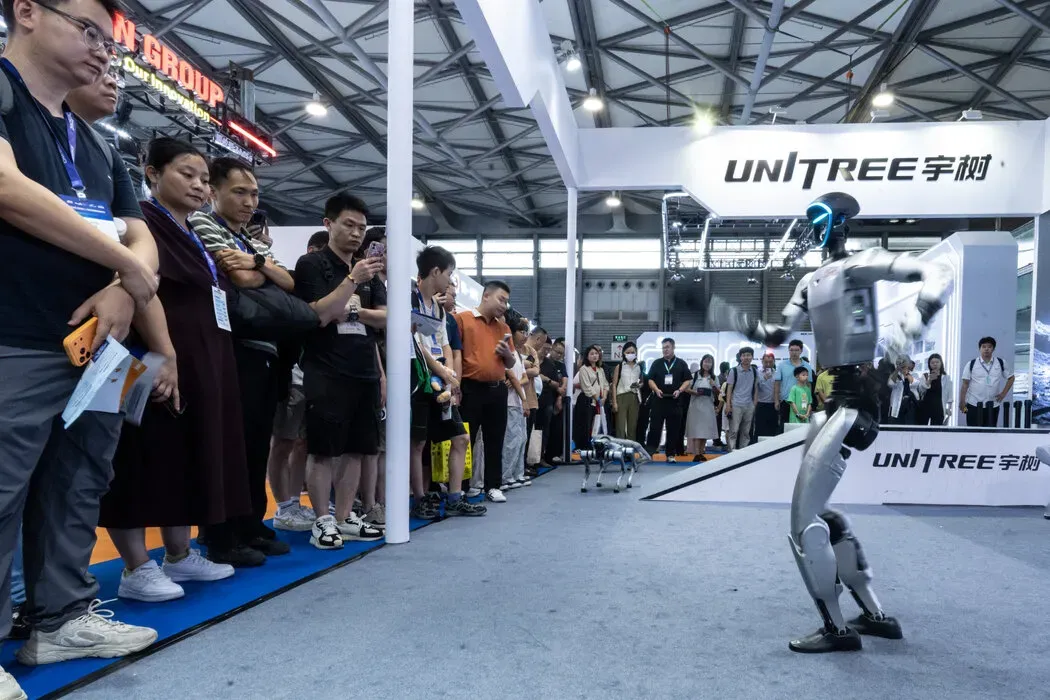
Robotics, once repeatedly discussed by investors and tech firms as a futuristic sector, is now moving into real-world industrial deployment.
The robotics sector may truly be entering a new inflection point.
On August 19, Unitree Robotics officially listed on the STAR Market, becoming one of China’s first publicly traded humanoid robot enterprises.
Meanwhile, Musk has kept up momentum on his end. Tesla Optimus continues to advance toward mass production. Robots are evolving from conceptual products showcased at product launches toward genuine commercialization.
One company rings the bell in China, while the other accelerates progress in the U.S. Though these appear to be separate events, they point to one overarching trend:
Robotics, once repeatedly discussed by investors and tech firms as a futuristic sector, is now moving into real-world industrial deployment.
A few years ago, during AI’s peak hype, conversations centered on ChatGPT, Copilot and AI Agents. Today, AI is stepping out from behind computer screens. It is entering factories, warehouses, automotive production lines, and even homes. That explains why a growing number of tech giants are shifting focus to robotics.
For international students hunting jobs in North America, what truly merits attention may not be Unitree’s stock price, nor when Optimus will enter ordinary households.
The critical question is this: if robots enter large-scale commercialization, which talent pool will be fought over first?
01 Unitree’s IPO, Musk’s Push: Is Robotics Entering Its Second Act?
When people previously talked about robotics, images often surfaced of industrial robotic arms and automated production lines. But the biggest shift in this wave is the rise of humanoid robots as the main protagonist.
Over recent years, Unitree has brought humanoid and quadruped robots into the public spotlight. Its journey from early product demos to landing on the capital market sends a clear signal: robots are no longer merely lab research projects; they are advancing toward full-scale industrialization.
Across the Pacific, developments in the U.S. market are equally notable.
Musk has long held ambitious plans for Optimus. Tesla’s vision is not simply selling individual robots, but building robots as intelligently connected hardware platforms scalable for mass manufacturing and continuous iteration.
Why does this matter?
Once robots move into mass production, the industrial chain will need far more than a handful of algorithm researchers.
In other words, when robotics achieves full industrial rollout, the benefits will not be limited solely to robotics majors. Graduates with backgrounds in CS, ECE, EE, ME, AI, Data Science, and even manufacturing, supply chain, product management and operations can find relevant opportunities.
This is exactly the key area international students in North America should pay close attention to.
02 What International Students Should Focus on: Not Robots, But the Roles Behind Them
Browse North American robotics job postings right now, and you will spot an interesting shift: job titles no longer fit the traditional definition of robotics roles.
For students with CS or AI backgrounds, career pages commonly list Robotics Software Engineer, Computer Vision Engineer, Machine Learning Engineer, Perception Engineer, and the fast-growing Robot Learning Engineer.
For those from ECE or EE tracks, core openings include Controls Engineer, Embedded Engineer, Robotics Hardware Engineer and Electrical Engineer.
International students majoring in ME or automation will find abundant opportunities as Mechanical Engineer, Robotics Engineer, Mechatronics Engineer and Manufacturing Engineer.
Even cross-functional data roles have emerged, including Robot Data Engineer, Robot Operator, Technical Program Manager and Field Robotics Engineer.
Many international students hold a misconception: if they are not Robotics majors, the robotics industry has nothing to offer them.
Quite the opposite. Robotics is inherently a highly interdisciplinary field. It reunites technologies previously siloed across CS, AI, EE, ECE, ME, control systems and manufacturing. That is why robotics is a high-priority area for students to prepare for in North America’s job market.
03 Which Robotics Roles Can CS / ECE / ME / AI Candidates Apply For?
To help you match your background with openings, here is a detailed mapping between common majors and robotics job tracks.
If your background is in Computer Science or Software Engineering, the most natural entry point is Robotics Software or Infrastructure roles. These positions heavily test proficiency in C++ and Python. Candidates are expected to be familiar with the ROS or ROS2 robotics operating system, with in-depth knowledge of Linux, middleware and distributed systems.
If you specialize in AI or Data Science, Perception, Robot Learning and Computer Vision are tailored for you. This is the core battlefield for reinforcement learning and embodied AI. Employers value hands-on PyTorch skills, alongside algorithm expertise in Computer Vision (CV), Reinforcement Learning and Imitation Learning.
For ECE and EE students, Embedded, Controls and Hardware roles are your strongest suit. Your tech stack should focus on embedded C/C++, Real-Time Operating Systems (RTOS), control theory, PCB design and microcontroller development — the critical bridge translating software instructions into physical hardware actions.
For ME and mechatronics students, there is strong demand in Mechanical Design, Actuator development and manufacturing. You need to master CAD modeling (SolidWorks or NX), dynamic and kinematic analysis, Finite Element Analysis (FEA), and hardware prototyping. Your work solves core physical challenges: helping robots move stably, reducing weight and speeding up production.
The AI boom has reshaped many pure software roles, and robotics may become the next major industry bridging the digital and physical worlds.
💡 Advanced Job Search Tips:
If you are preparing for North American fall or spring recruiting and unsure how your major aligns with robotics, autonomous driving or AI hardware roles, start by listing out your technical skillset. Use the role mapping above to restructure your project portfolio in a targeted way.
The earlier you act, the clearer your career roadmap will be.