
 MentorX
 0
0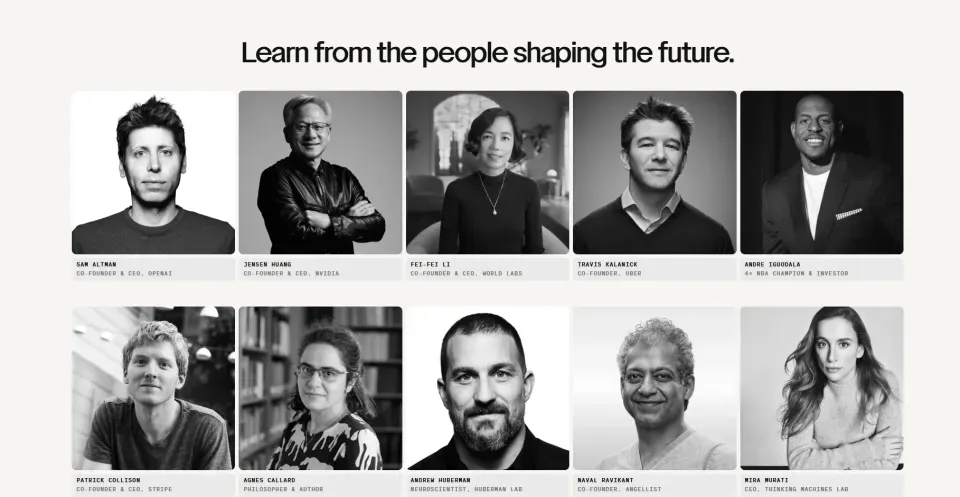
In late September, prominent Silicon Valley venture‑capital firm Andreessen Horowitz (a16z) officially announced the incubation and funding of the Horowitz Andreessen Academy (HAA), based in San Francisco. Representing a higher‑education experiment for the AI era, this initiative also ushers in a brand‑new chapter in which capital moves proactively to court top young talent.
What can schools offer when AI can retrieve knowledge, write code and conduct research? Top‑tier Silicon Valley venture‑capital firm a16z has its answer: build an academy directly to lock in prospective tech founders starting at age eighteen.
In late September, prominent Silicon Valley venture‑capital firm Andreessen Horowitz (a16z) officially announced the incubation and funding of the Horowitz Andreessen Academy (HAA), based in San Francisco. As a higher‑education experiment for the AI era, this initiative also ushers in a brand‑new chapter where capital proactively courts gifted young talent.
What Kind of Academy Is This?
The project has an initial total funding of $42 million, of which a16z contributed $35 million.
Its inaugural cohort will kick off in Fall 2027. It is a one‑year full‑time in‑person program admitting roughly 50 students. Tuition is waived, while students cover their own room, board and living expenses. The program targets high‑school graduates and also accepts international applicants.
For 2028, the academy plans to secure regulatory approval to launch a two‑year program with tuition aligned with elite U.S. private universities, at approximately $60 000‑$90 000 per year.
It completely upends the traditional university model:
✅ No transcripts or standardized‑test scores for admissions. Acceptance hinges solely on **completed project work**.
Students are selected using the venture‑capital logic of screening early‑stage startups via *proof‑of‑work*. What products you have built and what projects you have delivered matter far more than grades.
✅ No formal exams or fixed homework assignments.
Courses take the form of modular short sessions ranging from two days to four weeks. Substantial time is reserved for student‑led projects, entrepreneurial exploration and research. Each student in the first cohort receives a $50 000 compute credit plus a $5 000 research‑travel budget. Students are also required to complete a minimum of three months of full‑time practical internships at partner organizations.
✅ Star‑studded roster of industry mentors.
Tech leaders including Jensen Huang, Sam Altman, Satya Nadella and Fei‑Fei Li serve as guest lecturers. The core educational philosophy: learn from the people who make textbook‑worthy breakthroughs, rather than from those who merely write textbooks.
Ten leading tech innovators including NVIDIA, OpenAI, Meta, Google and Anthropic are founding partners, providing computing resources, hardware, co‑developed curricula and hands‑on opportunities. That said, there are no guarantees of internships or full‑time job offers, internships may be unpaid, and students still need to go through standard corporate interview processes.
⚠️ Critical reality check: The inaugural program holds no official educational accreditation. It does not grant university degrees or academic credits, and students cannot access federal financial aid. This is not a conventional university; it is a venture‑capital‑led talent‑development program.
Why Is a Venture‑Capital Firm Building a School? The Business Logic Behind a Talent Flywheel
a16z repeatedly stresses that most young people are still well‑served by traditional universities. Yet a subset of highly‑ambitious young learners who struggle within conventional classrooms deserve alternative pathways. Look beyond its educational rhetoric, however, and a clear commercial strategy emerges.
AI is reshaping the employment landscape. Entry‑level baseline roles face disruption from AI, shrinking new‑grad hiring pipelines. Meanwhile, the productivity of the tiny fraction of young creators who can harness AI is multiplied many times over.
This creates a tension for capital: companies dial back hiring for rank‑and‑file junior staff yet compete fiercely for the most gifted talents at the top of the talent pyramid.
Silicon Valley previously saw the Thiel Fellowship, which encouraged people under 22 to leave school to launch startups. Today, capital’s talent hunt has moved even earlier — from college dropouts all the way to high‑school graduates.
At its core, a16z’s academy builds a pre‑emptive talent pipeline:
1. Gain early access to potential founders before they launch startups, opening opportunities to invest in entrepreneurs spawned by the academy down the line;
2. Identify and source promising prospective employees for a16z’s extensive portfolio companies;
3. Overlay three identities — student, intern and prospective investment target — to close the loop of “talent → internship → entrepreneurship → investment”. The boundaries between school, employer and investor dissolve, breaking away from the independent, check‑and‑balance relationships under traditional social division of labor.
This aligns with an internal a16z concept: *“When venture eats the world.”*
As predicting winning companies grows increasingly difficult, capital is shifting toward controlling more foundational levers: talent, personal networks and industry influence, rather than only investing in mature existing businesses.
Heated Debate: Innovative Education or Elite Bootcamp?
This model carries stark inherent contradictions.
1. The paradox of signaling value
Without official degrees, the program relies entirely on the brand credibility of a16z and major tech giants to function as a “new‑form diploma”.
The extremely small incoming cohort of only 50 students lends heavy weight to this brand endorsement. Should enrollment expand, that reputational premium will erode rapidly. Mainstream society still values university‑degree credentials, and employers will remain cautious toward candidates without formal academic qualifications.
2. Real‑world challenges around high tuition
Free tuition for the first cohort serves as a proof‑of‑concept phase. Post‑2028 plans call for tuition comparable to Harvard, yet students will receive no accredited degree and cannot rely on student‑loan financing.
The biggest open question for the program is why middle‑class families would bear steep costs purely to purchase reputational backing from a venture‑capital firm.
Even scholars critical of traditional higher education remain skeptical about its scalability. They characterize it as little more than “a high‑end career bootcamp packaged as a university”.
3. Built for an extremely narrow group
The entire system caters to top‑tier young creatives who can already produce tangible project output. It is wholly unsuitable for average students. It addresses none of the pain points of mass higher education and serves only a small pool of gifted individuals.
Takeaways: Education Is Forking in the AI Era
The HAA experiment mirrors broader shifts unfolding across global higher education:
1. In the AI era, knowledge memorization is no longer a core competitive edge. Greater weight falls on hands‑on project delivery, collaborative networks and real‑world problem‑solving capabilities.
2. Beyond public and private universities, capital and industry players are stepping in to offer more “university alternatives”.
3. Draw a clear distinction: industry‑backed educational initiatives blend educational ideals with commercial motives. While students gain resources and connections, they simultaneously become talent subjects to be observed and screened.
Ben Horowitz, co‑founder of a16z, argues the AI revolution will impact employment on a scale comparable to the Industrial Revolution, calling for pioneers to explore new educational pathways.
Whether this model can succeed remains to be seen. The first cohort of 50 students may deliver a compelling success story, yet scaling the program will expose structural flaws.
For the lucky participants admitted tuition‑free in 2027, this will likely represent a high‑upside opportunity. Future students paying full tuition, by contrast, will face far greater risks and uncertainties than those attending conventional universities.