
 MentorX
 2
2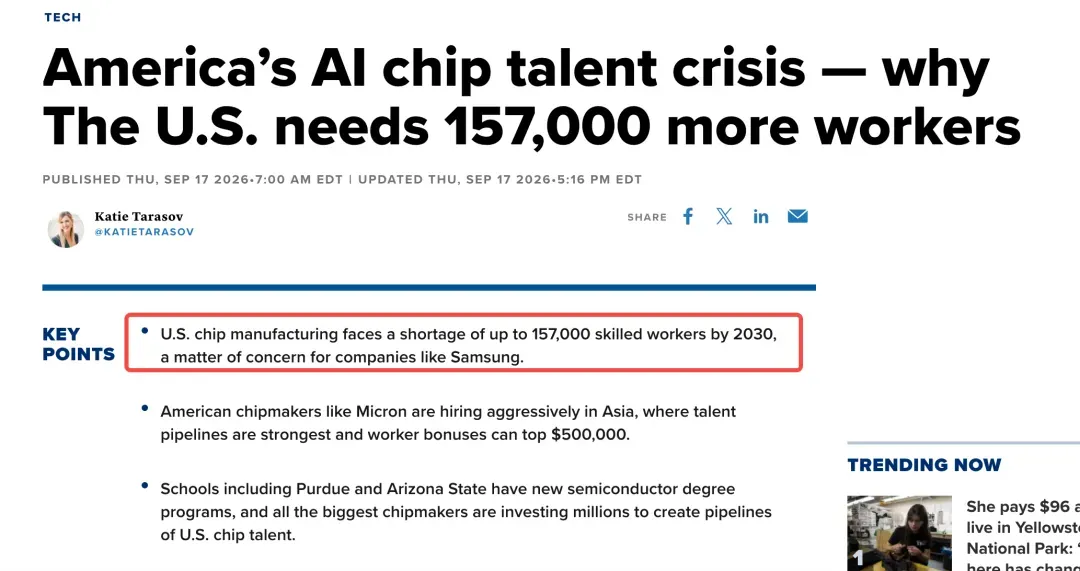
While candidates keep flocking to SWE, Data and AI roles, the tech industry on the other side of the U.S. is grappling with a more pragmatic challenge: Factories are being built, yet there are not enough people to operate them.
Over the past two years, the most familiar news for international students navigating U.S. job hunting has probably been tech layoffs, shrinking software hiring, and debates over whether AI will displace entry‑level roles.
Yet while candidates keep flocking to SWE, Data and AI tracks, the tech industry on the other side of the United States is grappling with a more pragmatic challenge:
Factories are being built, but there are not enough people to operate them.
CNBC reported on September 17 that the latest analysis from McKinsey and the SEMI Foundation projects the U.S. semiconductor and microelectronics industry could face a talent shortfall of 127,000 to 157,000 workers by 2030.
Jon Taylor, a senior executive at Samsung Semiconductor, voiced clear concerns, as the pipeline of skilled technical talent is failing to keep pace with factory ramp‑ups. Seventy‑three percent of semiconductor employers report significant difficulty filling engineering roles. Among U.S. graduates who take engineering jobs each year, only around 3% enter the semiconductor sector.
For international students currently job hunting in the U.S., the real takeaway from this report is not that “157,000 jobs are waiting for you.” Rather, talent demand is shifting away from the overcrowded software pipeline toward hardware‑heavy and physical production segments such as chip manufacturing, equipment, and advanced packaging.
01 The U.S. needs more than just chip design engineers
When talking about semiconductors, many students immediately think of chip design: Verilog, digital circuits, analog ICs. It often seems opportunities are reserved only for EE majors.
But a fully functional wafer fab requires far more than design engineers.
From wafer input, through deposition, photolithography, etching and metrology, to yield enhancement and equipment maintenance, every stage calls for specialized personnel. Key roles identified by McKinsey include:
Process Engineer
Equipment Engineer
Industrial Engineer
Quality Engineer
Facilities Engineer
Area Operator
Maintenance Technician
In other words, the talent gap spans engineering, technician and production support positions. It cannot be simplified as a shortage of 157,000 chip design engineers.
This also means opportunities are not limited to traditional EE students:
Materials majors can target thin films, material characterization and failure analysis
Chemical engineering candidates can pursue process work, wet processing and contamination control
Mechanical engineers may focus on equipment, automation, thermal management and facilities engineering
Physics backgrounds fit device development, process integration and metrology
Industrial engineering aligns with manufacturing optimization, yield improvement and supply chain
Your major is merely an entry point. Employers ultimately want to see proof — from coursework, lab work, internships and projects — that you understand relevant processes or equipment.
02 Why the U.S. is suddenly facing workforce shortages
Factory construction is translating into real production capacity
TSMC states its first three Arizona wafer fabs are expected to create roughly 6,000 direct high‑tech jobs. Samsung’s Taylor project covers advanced logic manufacturing and R&D; its investment is projected to generate more than 3,500 direct manufacturing roles over the next five years. Micron is also moving forward with advanced memory manufacturing projects in Idaho and New York.
Domestic U.S. expertise has not grown in parallel
Credit: CNBC
Advanced chip manufacturing has long been concentrated in Asia, along with its seasoned workforce and training infrastructure. CNBC reports that Samsung and SK Hynix are temporarily deploying Korean staff to help launch their new U.S. fabs; Micron has even recruited directly from Korean universities.
Companies need people who can work with equipment, understand workflows and quickly step onto the production floor.
Engineering talent has long been siphoned by software and internet industries
Earlier McKinsey research estimates that roughly 1,500 engineering professionals join the U.S. semiconductor industry each year. Meanwhile, new wafer fab jobs are geographically concentrated, requiring candidates to work on‑site in manufacturing environments, with some positions involving shift work.
This mismatch — industry demand for workers paired with student reluctance to take factory roles — is one major driver of the widening talent gap.
03 Which international students should prioritize this career path
If you hold a degree in EE, Materials, Mechanical, Chemical Engineering, Physics or Industrial Engineering yet have been competing against CS students for general software roles, this news warrants a reassessment of your strengths.
You may not need a full career pivot; you simply need to translate your existing experience into language hiring teams understand.
Three groups of students are especially well positioned:
Those with experience in cleanrooms, microfabrication, material characterization or device experiments
Those familiar with automated equipment, vacuum systems, reliability testing or quality control
Those open to expanding their job search to major manufacturing hubs
Still, an industry talent shortage does not guarantee easy job offers for international students.
The 157,000 figure is the upper bound of 2030 projections, covering all education levels and job types. It does not mean all these openings are available for new graduates or offer visa sponsorship. Work authorization requirements must be verified role by role; macro‑level workforce gaps cannot replace individual job description review.
04 What to start preparing right now
Narrow down your target roles
Avoid searching only for “Semiconductor Engineer.” First decide whether you are better suited for Process, Equipment, Yield, Quality, Packaging, Facilities or Manufacturing. Then review 20–30 job descriptions to identify recurring keywords for equipment, processes and software tools.
Turn “I studied this” into tangible evidence
Course titles carry limited weight. What matters is which experiments you ran, what materials or datasets you handled, and how you diagnosed problems. Even without direct internships, you can pull relevant evidence from lab projects, capstone work and research assistantships.
Seek hands‑on opportunities
Intel has launched a manufacturing facility technician apprenticeship program in Arizona, explicitly noting the small talent pool for these roles. U.S. universities and community colleges are also expanding semiconductor training programs.
For currently enrolled students, hands‑on exposure to cleanrooms, equipment and manufacturing workflows often creates more differentiation than taking another generic programming course.
When everyone chases the hottest openings, competitive advantage sometimes comes from deeper, granular understanding of the industrial supply chain.
Semiconductor manufacturing opportunities in the U.S. will not fall into international students’ laps. But for candidates with hardware, process, materials and equipment backgrounds, this is a track worth exploring early — rather than scrambling to switch after graduation.
Industry expansion does not mean every major should blindly pivot into semiconductors. The real challenge is evaluating how your coursework, research and internships fit specific roles, then reframing your experience into clear, verifiable proof of capability for employers.