
 MentorX
 77
77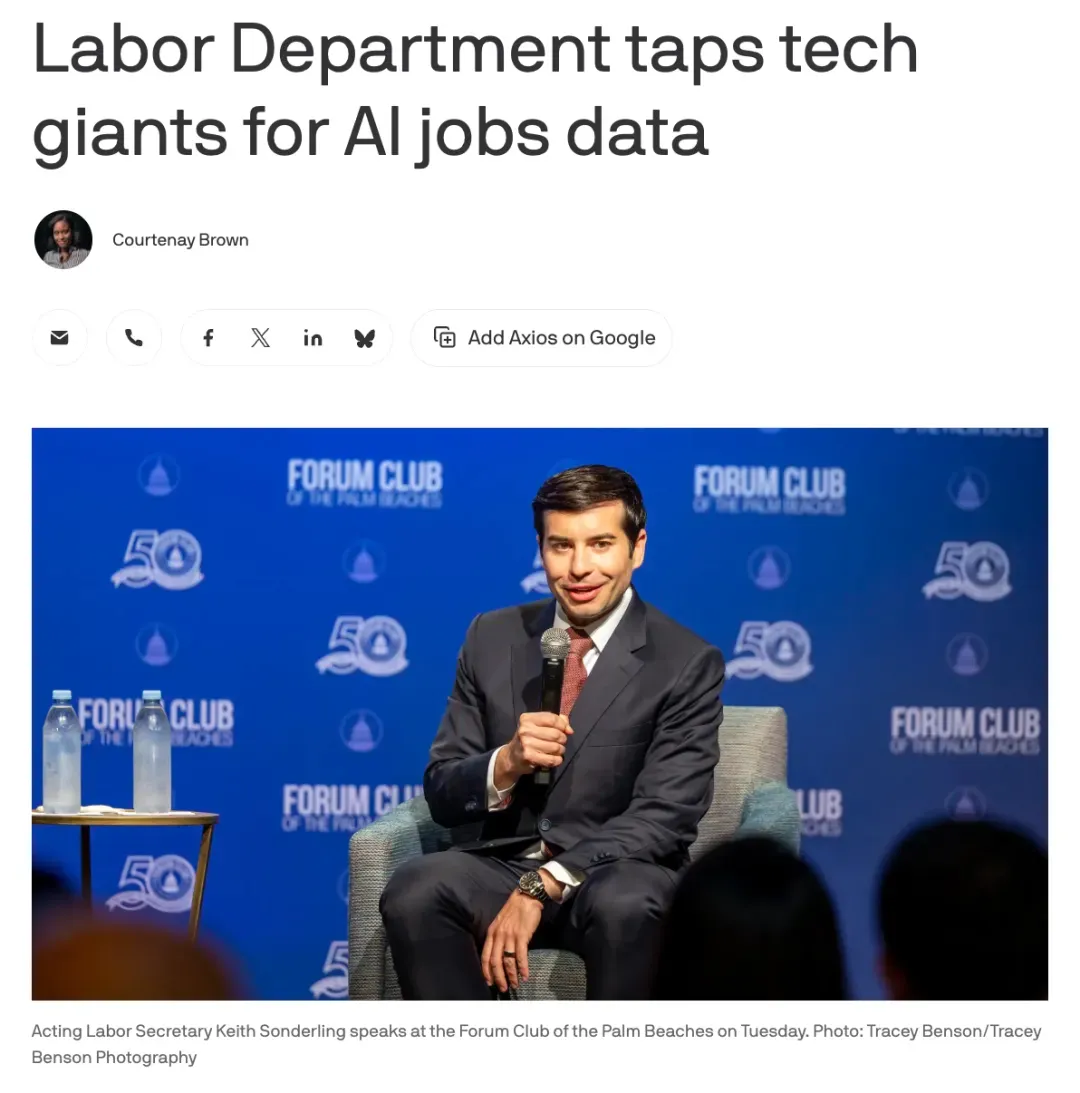
Since AI entered the workplace, many international students have relied on questions like these to gauge their futures. But a recent initiative by the U.S. Department of Labor serves as a reminder: rather than broadly asking “which majors will be replaced by AI,” it is better to first understand exactly which parts of a job AI is transforming.
“Is computer science still a safe major?”
“Will business majors be the first to be replaced by AI?”
“Is it still too late to pivot toward AI now?”
Since AI entered the workplace, many international students have relied on questions like these to gauge their futures. But a recent initiative by the U.S. Department of Labor serves as a reminder: rather than broadly asking “which majors will be replaced by AI,” it is better to first understand exactly which parts of a job AI is transforming.
According to Axios, the U.S. Department of Labor (DOL) has reached data-sharing partnerships with several large tech companies, including OpenAI, Google, Meta and Amazon. The Labor Department hopes to leverage data from these firms to better understand how businesses deploy AI, which use cases they plan to adopt in the future, and how these shifts may impact jobs and hiring.
This does not mean the U.S. government has concluded that AI will trigger mass unemployment. On the contrary, it shows AI’s impact on employment is growing increasingly complex. Traditional statistical methods may no longer capture rapid real-time changes as they unfold.
01 Why the DOL Is Asking Tech Firms for Data
Conventional employment statistics rely on corporate surveys, data collection and modeling to help the government track workforce numbers, wage levels and industry trends. However, these methods inherently carry a time lag.
AI-driven transformations can happen far faster.
When a company rolls out generative AI, it may not eliminate an entire role overnight. A more common pattern is: first revamp team workflows, automate repetitive tasks, then adjust hiring volumes and candidate requirements. Changes of this nature cannot be fully captured merely by counting how many new roles are created or how many workers are laid off.
In the Axios report, Acting U.S. Labor Secretary Keith Sonderling stated plainly that the government currently lacks sufficient data. Large tech firms and Fortune 500 companies heavily impacted by AI hold the clearest insight into enterprise AI adoption. Per the report, private-sector data supplied by tech companies will supplement official government statistics, and findings from the research will be released publicly later.
The significance of this development extends beyond giving the government an extra data source. It signals that discussions about AI in the U.S. job market are shifting from “which occupations will disappear” toward deeper questions: “Where exactly are companies deploying AI within workflows?” and “How are tasks redistributed within existing roles?”
For international students preparing for U.S. job searches, the latter set of questions carries far more practical relevance.
02 AI Reshapes Work, Not Entire Majors
We tend to understand the job market through majors and job titles: Finance graduates target finance roles, Marketing graduates pursue marketing positions, and Computer Science graduates apply for software engineering jobs.
But AI does not necessarily erase a job title from career boards. More often, the title stays, while the day-to-day work evolves.
Marketing roles still require user insight and strategy design, yet AI may handle much of the research, first-draft content and basic analytics. Finance roles still demand modeling, risk assessment and business judgment, though AI can accelerate information compilation and report generation. Software engineers will not become obsolete simply because of code-generation tools, but employers will raise the bar for development efficiency, code validation and system integration skills.
Therefore, different tasks within the same major can experience vastly different levels of AI disruption.
The U.S. Bureau of Labor Statistics has integrated AI’s potential impacts into employment projections, explicitly noting varying degrees of uncertainty around its forecasts. Key fields under review include computer and mathematical sciences, business management, law, arts, design and media. The research is not simply declaring which jobs will vanish; it analyzes how technology alters specific tasks and workforce demands.
This is a point many international students overlook: your major represents your educational background, the job is your target, and individual tasks are what employers actually pay for.
Asking only whether “my major is safe” yields overly generalized answers. It is more valuable to track which tasks within your target role are being automated, which are becoming human-AI collaborative workflows, and which skills grow more critical precisely because of AI adoption.
03 How International Students Should Prepare Now
Step 1: Do not only research majors — break down target job roles.
Pull 10–20 job descriptions for your target positions. Categorize responsibilities into buckets: research, analysis, content/product creation, communication & collaboration, judgment & decision-making, and project delivery. This reveals what capabilities employers are truly paying for.
Step 2: Assess how AI interacts with each task.
Some repetitive tasks may be fully automated. For others, AI produces first drafts for human review. Certain work requires judgment rooted in organizational context, client needs and risk accountability. Avoid binary labels of “replaceable” vs “safe.” Instead, examine how the human’s role is shifting.
Step 3: Build AI skills tailored to your target roles, instead of blindly switching majors to chase trends.
Finance students can explore AI-assisted financial analysis workflows. Marketing students can build pipelines from user research to content evaluation. SWE candidates can demonstrate using AI to boost development velocity while mitigating bugs. The goal is not to brand yourself as an AI expert, but prove you can apply AI properly within your core domain.
Step 4: Structure resumes and interviews around your full problem-solving workflow.
Rather than listing “proficient in multiple AI tools,” employers want to know: What problem did you face? Why did you select this approach? How did you validate the outputs? What improvements did you deliver? Even smaller projects carry more weight if the process is concrete and results are verifiable, compared to a simple laundry list of tool names.
The DOL’s data-sharing initiative with tech companies does not hand students a fixed prediction of the future. Its bigger signal is this: AI’s employment impact is being measured at a much finer granularity, and employers will evaluate talent with increasing specificity going forward.
So instead of repeatedly asking whether your major will be replaced by AI, start figuring out early:
After AI enters this role, what kind of professionals will companies continue to pay for?