
 MentorX
 2
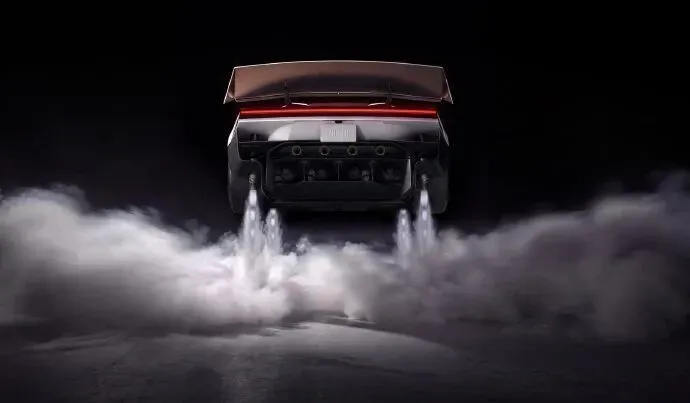
Everyone is asking, “Can cars really fly?” — yet this is the least important question. What truly merits unpacking are the three layers of logic behind this narrative.
The event unfolded at SpaceX’s rocket‑test facility in Texas.
A two‑seater sports car charged up an almost‑vertical wall, clung upside‑down to the ceiling, flipped halfway through the air, blasted supersonic exhaust with Mach rings from its rear, and descended slowly like a rocket.
It accelerates from 0 to 100 km/h in under one second. This was no sci‑fi movie set — it was the unveiling of Tesla’s second‑generation Roadster.
Elon Musk gave it this label: “the ultimate masterpiece of the human‑driving era.”
Everyone is asking, “Can cars really fly?” — yet this is the least important question. What truly merits unpacking are the three layers of logic behind this narrative.
I. Flight Is Not the Selling Point; the Farewell Is
Numbers such as 80 000 newtons of thrust, 2 G of suction force, sub‑one‑second 0‑100 km/h acceleration, and wall‑clinging upside‑down stunts are undeniably spectacular.
Bear one point in mind: these visceral mechanical thrills only hold meaning when a human occupant sits behind the steering wheel.
That captures the core of Musk’s remarks.
Once autonomous driving becomes mainstream, the act of a human manually manoeuvring a mechanical beast to push physical boundaries will itself become a luxury. Much like horse‑riding today — once a mode of transport, now a form of recreation.
At its core, the Roadster 2 is a love‑letter‑style farewell to the fading era of human‑operated driving. It does not sell flight; it sells the last dignity of human hands still commanding raw speed.
II. A Test‑bed for SpaceX Technology Reaching Down to Civilian Use
The choice of venue — SpaceX’s rocket test‑and‑development site — is no coincidence.
The A71 cold‑gas thruster system, rocket‑style vertical landing, and under‑car suction fans are all direct adaptations of SpaceX aerospace technologies.
What can a sports car accomplish? It validates aerospace‑grade technology at relatively low cost, builds out supply chains, accumulates real‑world flight data, and lets the consumer market underwrite aerospace R&D.
Seen in this light, the Roadster 2’s target customers are hardly sports‑car enthusiasts. Instead, it forms Musk’s technical reserve for future low‑altitude economy applications, vertical‑take‑off‑and‑landing vehicles, and personal‑aviation interfaces.
Aerospace provides the technology, the car serves as the delivery vehicle, and data feeds AI. This is a classic “technology trickle‑down” playbook: take capital‑intensive space‑born tech, bring it down to earth for monetisation, iteration, and mutual reinforcement.
III. Nine‑Year Delays: Timelines Are Fundamentally Marketing Rhetoric
First unveiled in 2017, originally promised for 2020 delivery, now re‑presented with mass production pushed to 2028. Twelve years will pass from its debut to real‑world rollout.
Do not dismiss this as a failure.
For a commercially‑minded businessman grounded in engineering realities, delays can represent honesty: a small step on a presentation slide translates into an arduous, enormous leap in the physical world.
That said, the RMB 332 000 fully‑refundable reservation deposit on Tesla’s Chinese website and the USD 5 000 deposit on its U.S. site do not effectively pre‑purchase a definite finished product. You are buying an option to “participate in the future”.
Pre‑orders become a form of finance: customer deposits act as leverage for Tesla to fund supply‑chain operations and cash flow.
Therefore, whether deliveries arrive on schedule in 2028 is secondary. What matters is that the technological roadmap is now clear.
Trend Observation: The Boundaries of Mobility Are Being Redefined
When an automaker ties cars to rocket technology, the ceiling for the mobility industry is shattered: automobiles → land‑based aircraft → personal‑aviation interfaces.
Over the coming decade, substantial industrial gains will cluster along three axes: AI (autonomous driving and flight control), energy (propulsion and endurance), and aerospace (low‑altitude economy and eVTOLs).
The low‑altitude economy is no mere concept; it is infrastructure taking tangible shape.
What does this mean for young people? The high‑value jobs emerging in the next decade will most likely sit at the interdisciplinary intersection of **AI × Energy × Aerospace**.
Major‑Selection and Career Advice for International Students
For international students and their families, the key takeaway from this trend is that the underlying logic for choosing university majors has shifted.
First, avoid fixating solely on siloed majors such as pure software or pure finance.
Real opportunities lie in interdisciplinary fields: aerospace engineering, robotics / mechatronics, electrical and energy engineering, AI and machine learning, materials science and fluid dynamics, control systems, and computer vision.
These disciplines share strong transferability: they open doors to AI, robotics, automotive, energy and aerospace sectors alike, offering far greater cyclical resilience than single‑subject trendy majors.
Second, evaluate options against **industry cycles**, not merely current salaries.
Career peaks for flying‑car, low‑altitude‑economy and embodied‑intelligence sectors have not yet arrived. Entering these fields now lets you build scarce capabilities rather than chasing over‑crowded fads.