
 MentorX
 1
1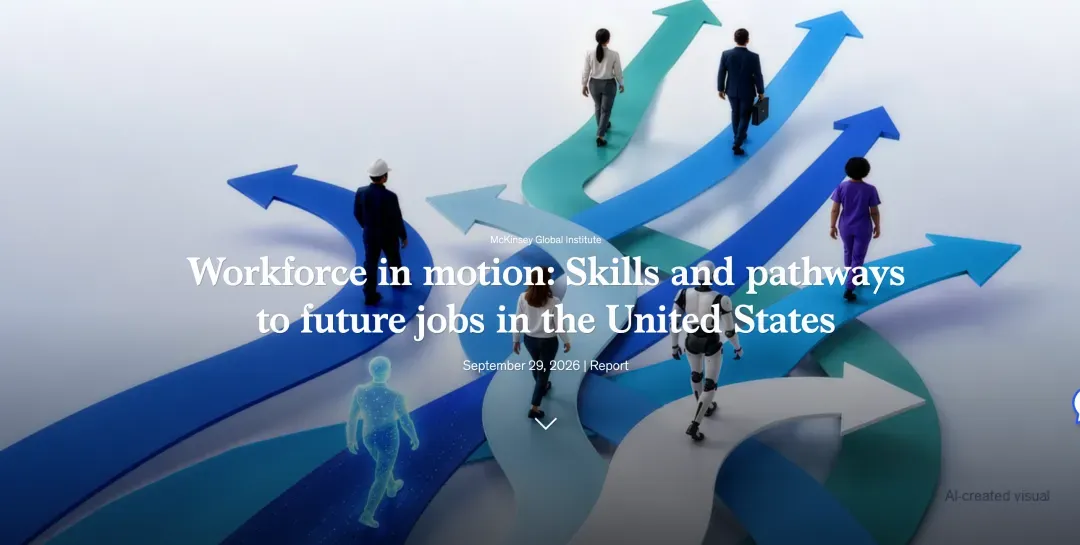
The report projects that by 2035, AI, automation, along with demographic and industrial‑structural shifts, could create roughly 41 million jobs in the United States. At the same time, automation may reduce labor demand equivalent to approximately 36 million full‑time positions.
McKinsey Global Institute has recently released a report on the U.S. job market.
The report projects that by 2035, AI, automation, as well as demographic and industrial‑structural shifts, could create roughly 41 million jobs across the United States. Meanwhile, automation may reduce labor demand equivalent to approximately 36 million full‑time positions.
When adding the gains and subtracting the losses, the U.S. job market could theoretically see a net increase of around 5 million jobs.
Beyond potential total‑job growth, many of these new openings offer solid compensation. McKinsey estimates that about 60 % of new jobs may fall within the two highest‑wage brackets.
Yet another set of data paints a completely different picture.
McKinsey also forecasts that roughly 11 million U.S. workers may need to switch occupations entirely, and over 70 % of workers will require skill‑updating to varying degrees. Only about one‑seventh of the workforce will be able to move into growing roles without substantial retraining.
We face a paradox: the U.S. may add a net 5 million jobs, yet tens of millions of existing workers need career reskilling.
Companies keep hiring AI‑talent, while new graduates find fewer entry‑level openings with ever‑higher requirements.
These two seemingly contradictory realities are unfolding simultaneously.
If the U.S. will not suffer a shortage of jobs in the future, why do international students today feel that job‑hunting is growing harder?
01 Understanding the Data Through Corporate Real‑World Actions
“Job growth” in macroeconomic statistics does not mean every industry, every company and every seniority level is expanding hiring.
Amazon’s recent moves serve as a typical example.
According to Reuters, Amazon has carried out another round of moderate corporate‑role layoffs, mainly within its Stores retail division. Fewer than 1,000 white‑collar employees in the U.S., United Kingdom, India and other locations were impacted.
If you only look at Amazon’s overall hiring volume, you could easily conclude the firm still needs massive talent.
At the divisional level, however, the same company can invest heavily in AI, cloud computing and infrastructure while trimming headcount within retail, operations and mature business lines.
“Amazon is still hiring” and “Amazon is still conducting layoffs” are not mutually exclusive.
Talent demand has not vanished, yet budgets are shifting from one category of roles toward others.
For international students, the critical question is no longer whether a company has open positions, but which departments are receiving resources, and whether your skill set aligns with these growing areas.
Dropbox: Do the same workflows still require the same number of people?
Dropbox illustrates another shift: companies may not eliminate roles outright, but recalculate how many staff are needed to deliver the same output.
Per Dropbox’s official engineering blog, AI‑tool adoption within its engineering teams has surpassed 90 %, up from low double‑digit figures back in 2024. AI tools are also spreading beyond engineering to product managers, designers, marketing and other functions.
In the past, junior engineers built experience by writing basic code and fixing simple bugs. New product‑team members would handle user‑feedback compilation, documentation and requirement follow‑ups.
Today these well‑structured, highly‑repetitive foundational tasks can be AI‑augmented.
The outcome is unlikely to be “all engineering jobs disappear”. More plausibly, the same volume of work no longer demands as many employees. Remaining roles place greater emphasis on validating AI outputs, business acumen and end‑to‑end delivery, rather than purely executing basic tasks.
Booking: Efficiency gains reshape hiring budgets
Disclosures from Booking Holdings offer even clearer evidence.
Management reported that after adopting AI development tools, the volume of code‑merge requests reaching production rose by roughly 30 %, even after accounting for quality‑control checks.
For the company, this means existing teams can deliver more output.
When drafting future hiring budgets, leadership will naturally ask:
‑ Do we still need to hire junior engineers at historical volumes?
‑ Can we reduce new‑hire headcount and redirect budgets toward candidates capable of owning projects independently?
‑ How much of the entry‑level workload can first be handled by AI?
Citi: Shorter timelines for new hires to prove their worth
Changes on Wall Street also deserve attention.
Citi’s currently posted 2027 New‑York Banking / Capital Markets Full‑Time Analyst role is explicitly a two‑year analyst program, whereas historically such programs commonly ran for three years.
New recruits now must complete training, build project track records and prepare for promotion within a compressed timeframe.
For international students targeting investment‑banking roles, companies are giving new hires less time to learn the business and demonstrate value.
Taken together, these corporate examples resolve the apparent contradiction in McKinsey’s numbers.
More jobs may emerge in the U.S. going forward, yet new openings may not come from contracting divisions, nor from the traditional white‑collar entry‑level roles familiar to international students.
Even when job titles remain unchanged, AI can boost individual productivity, allowing firms to accomplish the same workload with fewer staff.
For international students, the core question is not simply “are there jobs in America?” It concerns which roles are expanding, how many new graduates employers intend to recruit, and what capabilities new hires are expected to possess upon joining.
02 Why International Students Bear the Brunt of These Shifts
AI first disrupts work typically performed by junior employees.
Early‑career staff commonly start with information gathering, basic analysis, document preparation, simple coding, report‑building and process follow‑ups.
Employers assess new hires’ reliability through these foundational assignments before assigning more complex responsibilities.
These very tasks tend to be well‑structured, repetitive and easy to validate — making them prime candidates for AI augmentation.
Positions may not vanish overnight, yet corporate demand for junior‑level headcount can decline. Work that once required five people may now be completed by fewer employees working alongside AI.
This represents AI’s most tangible impact on entry‑level hiring:
It may not wipe out entire professions, yet it can reduce the volume of new graduates companies choose to bring on board.
Employers favor candidates who can deliver immediate value
Recruiting and sponsoring an international student carries inherent extra uncertainty.
Beyond skill fit, firms must weigh graduation timelines, work authorization, visa sponsorship obligations and long‑term retention risk.
If new hires need several months just to master tools, learn business context and integrate into teams, employers may lean toward applicants with relevant internship experience who can become productive quickly.
This explains why many international students perceive contradictory hiring requirements:
Roles are officially labeled “Entry‑Level”, yet candidates are expected to have completed comparable projects, mastered industry tools and even solve real‑world business problems independently.
Hiring managers understand these are junior‑grade openings, yet they are less willing to sustain lengthy on‑the‑job training cycles than in the past.
Mismatch between newly‑created roles and displaced roles
McKinsey’s projection of 41 million new jobs does not translate into 41 million graduate‑friendly office‑based openings for international students.
New demand spans healthcare, construction, infrastructure, energy and in‑person services. Many such positions require licenses, professional certifications, geographic constraints or citizenship‑related eligibility, and are not straightforward options for international graduates.
Meanwhile, shrinking categories including office support, retail sales and certain standardized knowledge‑work roles have long served as traditional on‑ramps for young talent entering the U.S. labor market.
The problem is not a lack of newly‑created jobs in the U.S., but rather:
‑ New roles may appear in different industries;
‑ New roles may cluster in different geographic regions;
‑ New roles may demand new technical skills or professional credentials;
‑ New roles may not be structured to train candidates straight out of university.
Job titles persist, yet job content has transformed
Tracking data from Revelio Labs indicates most AI‑driven change occurs within existing occupations, rather than eliminating entire career paths.
Software engineer, data analyst, consultant and financial‑analyst titles will likely endure, yet day‑to‑day responsibilities, evaluation criteria and hiring volumes may shift substantially.
For software engineers, companies still need talent capable of system design, business understanding and complex problem‑solving, while reducing junior‑focused roles limited to basic coding and minor modifications.
Data‑analysis roles will not disappear entirely, yet candidates whose skill set is limited to data cleaning, chart‑building and summary reporting will face growing AI‑driven competition.
Unchanged job titles do not equal unchanged hiring thresholds.
International students are facing a subtle upward shift in hiring bar:
Job titles remain visible, but hiring headcount may shrink; postings still read “Entry‑Level”, yet capability expectations creep toward mid‑level standards from previous years.
This is less “AI stealing jobs” and more hidden threshold elevation.
03 Actionable Guidance for International Students
Do not merely learn AI tools — demonstrate how you deliver work using AI
Listing “proficient with ChatGPT” on resumes provides almost zero competitive differentiation.
Employers care whether you have leveraged AI to cut analysis timelines, improve code quality, automate workflows or solve concrete team problems.
Instead of enumerating tool names, walk through complete workflows in resumes and interviews:
‑ What business problem were you addressing?
‑ How did you decompose the task?
‑ Which steps involved AI assistance?
‑ How did you validate AI‑generated outputs?
‑ What verifiable outcomes did you achieve?
Knowing how to operate tools is only the starting point; accountability for final deliverables is what employers truly value.
Prioritize experiences covering full end‑to‑end workflows, not isolated repetitive subtasks
High‑value internships and projects increasingly involve more than executing discrete repetitive steps. They expose you to complete business cycles:
‑ Defining requirements
‑ Diagnosing problems
‑ Coordinating stakeholders
‑ Handling edge‑case exceptions
‑ Owning final outcomes
Within data‑analytics projects, demonstrating only data cleaning and visualization work yields diminishing returns.
Far stronger impact comes from illustrating how you defined metrics, uncovered business pain points, tested hypotheses and influenced real‑world decisions.
When evaluating internships, do not fixate solely on company prestige. A role granting ownership of small‑scale projects can outweigh brand‑name internships limited to basic execution‑level work.
Conduct job research down to company and team level
Avoid high‑level checks such as “is the tech sector hiring?” or “does this firm have open roles?”
Dig deeper:
‑ Which business units are receiving investment?
‑ Which teams are expanding?
‑ Which functions are undergoing restructuring?
‑ Is the company prioritizing growth, cost‑cutting or AI‑driven transformation?
‑ Does the target team have a documented track record of hiring international students?
While Amazon scales back certain corporate retail positions, it continues pouring resources into AI and cloud divisions.
For international students, corporate brand prestige matters less than understanding where internal resources are flowing.
Build skill adjacency across related job families
If your target roles are contracting, do not wait until graduation to pivot.
Proactively explore adjacent roles where your existing expertise is transferable:
‑ Data‑analysis backgrounds can extend toward product analytics, risk analytics, operations strategy or AI‑evaluation work;
‑ Software‑engineering skills can expand into AI‑application development, model assessment, data engineering and cloud‑infrastructure domains;
‑ Finance‑focused candidates can build capabilities in automated analysis, data processing and industry research;
‑ Marketing‑track students can develop marketing analytics, user‑research and AI‑workflow‑design skills.
Career pivots do not require discarding your original major; they enable your existing strengths to qualify you for broader sets of openings.
Avoid pinning all hopes on one single job title; build a portfolio of mutually transferable career options.
Shift your overall job‑hunting timeline earlier
As firms reduce entry‑level hiring and shorten training windows, international students cannot afford to start preparation only shortly before graduation.
Build projects, internships and industry awareness from earlier academic years. Finalize resumes, practice interviews and map target employers well before official recruiting cycles kick off.
Students requiring work‑visa sponsorship should research an employer’s history with international‑student hiring early on, rather than raising immigration questions only after securing interviews.
AI has not erased jobs in the U.S. labor market.
It is redefining what qualifies as a competitive new‑graduate candidate.
Previously, employers might hire promising graduates and invest two‑to‑three years to build their independent work capabilities.
Today companies increasingly expect new hires to arrive already capable of leveraging AI, understanding business context, validating outputs and driving projects forward.
Key risk for international students
The greatest danger is not lack of familiarity with one particular AI tool. It is preparing yourself according to old‑world role expectations for a job market whose ground rules have already shifted.
Opportunities may still exist, yet the pathways to land them have changed.