
 MentorX
 0
0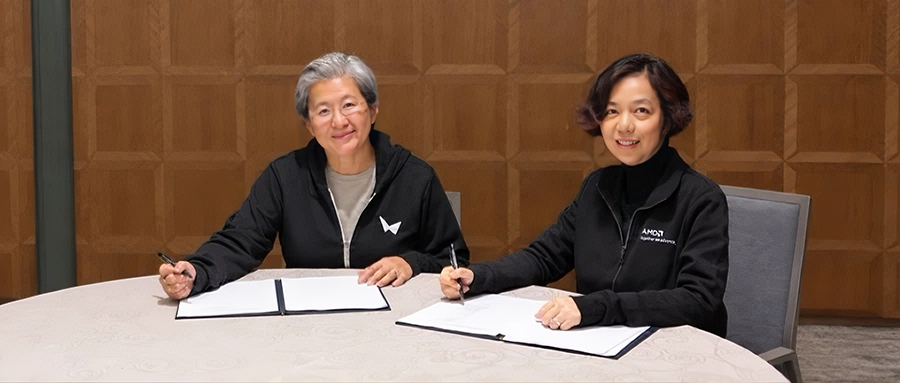
AMD has officially announced a transformative deal sending ripples across the global AI industry: it will acquire Fei‑Fei Li‑founded World Labs for $8.2 billion in an all‑stock transaction. This marks AMD’s second‑largest acquisition in its corporate history. The transaction is expected to close by the end of 2026 and remains subject to regulatory approvals across multiple jurisdictions.
AMD has officially announced a transformative deal sending ripples across the global AI industry: it will acquire World Labs, founded by Fei‑Fei Li’s team, for $8.2 billion in an all‑stock transaction. This represents AMD’s second‑largest acquisition in corporate history. The transaction is expected to close by the end of 2026 and remains subject to regulatory approvals across multiple jurisdictions.
Upon deal closure, Fei‑Fei Li will serve as AMD’s Executive Vice President and Chief Scientist, reporting directly to AMD CEO Lisa Su.
The pairing of two highly influential Chinese‑American women leaders in global technology marks a fundamental shift in the competitive dynamics of the AI sector.
Following the announcement, the most immediate industry question is: how can a two‑year‑old startup with roughly 70 employees justify an $8.2‑billion valuation?
World Labs has yet to generate large‑scale commercial revenue. The sky‑high valuation assigned by capital markets is not driven by its current cash flow, but by its core assets built for next‑generation AI.
I. Inherent Limitations of Large Language Models: Proficient Only in 2‑D Information, Unable to Grasp the Real Physical World
Generative large models familiar to the public over recent years are essentially “intelligence for text and flat images”.
ChatGPT and various multimodal large models excel at reading text and parsing two‑dimensional images, enabling Q&A, copy generation and 2D image creation.
Nevertheless, they suffer from a critical, hard‑to‑remediate shortcoming: a lack of understanding of real‑world three‑dimensional physical space.
When humans look at a photo of a room, we can instantly judge object distances and dimensions, and even mentally reconstruct scenes from alternative viewpoints. Traditional multimodal models only identify pixels and textual semantics without comprehending 3D geometric structures.
When camera angles shift, objects become occluded, or environments change dynamically, these models frequently produce flawed spatial logic. This is the root cause behind persistent real‑world deployment hurdles for AI in robotics, autonomous driving and digital twins.
World Labs targets exactly this bottleneck.
Its core product Marble generates geometrically consistent 3D spatial scenes from text, image and video inputs. Its next‑generation Atlas model reconstructs scene structures from a single 2D image and predicts how scenes would appear from entirely new camera perspectives.
This capability blurs the boundary between virtual simulation and the physical world, supporting use‑cases including virtual robot training, AR spatial reconstruction, architectural digitization, and 3D asset generation for film and television.
World Labs previously acquired SceniX to strengthen its robotics‑simulation capabilities, allowing agents to run massive volumes of trial‑and‑error testing within virtual environments before carrying out tasks in the physical world.
Put simply, World Labs aims to build a “spatial brain” for AI to perceive the three‑dimensional world.
II. The Acquisition Is Not Merely “Buying a Team”: AMD’s Strategic Push to Build Up Full‑Stack Capabilities
The AI industry has long followed a clear division of labor: model companies develop algorithms, while chip vendors solely supply compute hardware.
Historically, chip firms could only passively wait for model iterations before optimizing hardware architectures for new models.
Lisa Su is breaking this old paradigm.
AMD’s core thesis: next‑generation AI computing platforms require hardware architectures pre‑optimized for the compute demands of world models, embodied intelligence and robotics simulation. Without deep involvement in model R&D, chipmakers will fail to keep pace with AI paradigm shifts and cede initiative in future compute races.
Acquiring World Labs brings world‑model research and development in‑house at AMD.
Hardware, compiler and model‑development teams will collaborate to characterize compute requirements for spatial AI, 3D reconstruction and physics simulation, feeding insights back into chip and software‑stack design optimizations.
This full‑stack approach — hardware moving upward into model development while models adapt downward to silicon — constitutes AMD’s key strategy to counter NVIDIA’s CUDA ecosystem moat. Superior standalone chip performance alone cannot disrupt the existing ecosystem. Only by building a hardware‑software closed loop of in‑house chips plus natively adapted models can AMD compete for influence over next‑generation AI.
III. Why World Labs Opted for Acquisition: Cutting‑Edge World‑Model Research Cannot Thrive in Isolation From Hardware
From Fei‑Fei Li’s team’s perspective, accepting the acquisition is also a rational business decision. World‑model and embodied‑intelligence research belongs to a compute‑intensive, long‑cycle sector.
Top‑tier algorithm startups face persistent high costs for training compute, alongside substantial bottlenecks for large‑scale engineering deployment.
Spatial‑intelligence R&D is far more than algorithm tuning. It demands deep coordination with low‑level chip drivers, simulation frameworks and hardware scheduling. Independent startups rarely assemble this complete set of resources.
By joining AMD, World Labs gains access to abundant compute resources, large‑scale engineering teams and industry customer channels to translate lab‑grade technology into commercial deployments.
IV. Industry Trend: Dividends for Pure‑Algorithm Startups Fade; Hardware‑Software Integration Becomes the New Norm
This merger sends a powerful signal across the AI startup landscape: the AI industry’s reward cycle is shifting. Standalone startups building only text‑focused large models relying purely on algorithm innovation face growing headwinds to independent success.
For AI targeting the physical world, robotics and spatial intelligence, models cannot operate in isolation from chips, hardware and simulation systems. More alliances and M&A integrations between algorithm teams and hardware vendors will emerge, as industry resources rapidly consolidate behind full‑stack giants. A singular algorithmic edge is rarely sufficient to sustain a complete commercial closed loop.
V. Practical Career Advice for STEM International Students
Shifting industry dynamics directly shape job‑search strategies for overseas STEM students. Below are grounded, real‑world recommendations rather than empty motivational advice:
1. Avoid over‑saturation within general‑purpose LLM tracks
Roles focused on large‑language models are extremely competitive with limited openings. The industry increasingly values cross‑functional talent with hardware‑software integration skills.
Algorithm‑focused students should build hands‑on experience in GPU tuning, model deployment and simulation‑engine engineering. Hardware‑oriented students should learn foundational concepts of multimodal systems, world models and robotics simulation; cross‑stack expertise commands strong interview premiums.
2. Expand your scope: explore spatial intelligence, robotics simulation and digital twins
Compared with the crowded LLM space, physical‑world AI is in an expansion phase. Overseas chip, robotics and tech companies keep expanding hiring in these fields, with relevant openings for CV, automation, EE and CS majors and relatively less fierce competition.
3. Prioritize hardware‑software co‑design projects and internships
Even before the acquisition, World Labs collaborated with AMD on joint GPU tuning. Industry‑oriented collaborative projects like these carry far more weight than class assignments.
Seek internships within cross‑functional hardware‑software teams, and aim to participate in projects covering 3D reconstruction, spatial perception and simulation to build tangible engineering‑delivery case studies.
4. View industry benchmarks with realistic expectations
Fei‑Fei Li and Lisa Su represent exceptional figures at the very top of the industry; do not benchmark your career trajectory against theirs. For job‑hunting, track sector momentum for niche verticals, align opportunities with your technical skill set, and build your project and internship portfolio incrementally.
AI competition is no longer merely a race over model parameter counts or standalone chip performance. Victory in next‑generation AI hinges on whether companies can build complete closed loops spanning chips, models, simulation and physical‑world scenarios.
AMD’s $8.2‑billion bet on world‑models signals that artificial intelligence has officially moved beyond the virtual text‑driven era into competition rooted in the real physical world.