
 MentorX
 119
119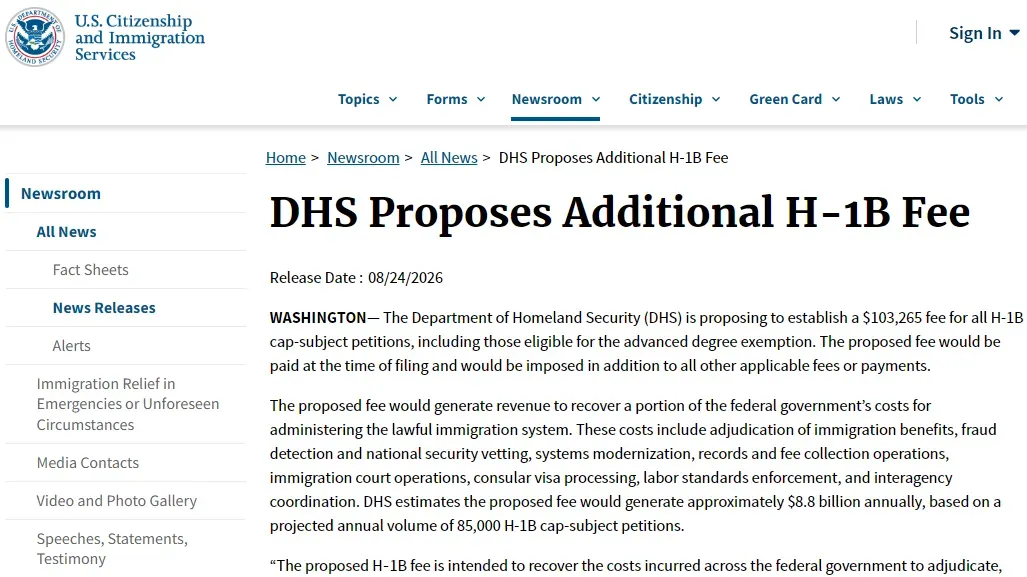
当地时间2026年8月24日,美国国土安全部DHS正式对外公布全新法规提案,计划对受配额限制的H‑1B工作签证新增103,265 美元的高额附加费。
On August 24, 2026 local time, the U.S. Department of Homeland Security (DHS) officially released a new proposed rule, planning to impose a steep surcharge of $103,265 on quota-limited H‑1B work visa petitions.
This is not the first time the Trump administration has put forward a six-figure H‑1B fee proposal. The $100,000 presidential executive order rolled out in 2025 was struck down by federal courts for overstepping authority.
This time, DHS reintroduced the measure in the form of a Notice of Proposed Rulemaking (NPRM), attempting to bypass previous legal hurdles. If finalized, the rule will profoundly reshape the pathways for Chinese international students and tech professionals seeking employment in the United States.
I. Core Highlights of the Official Proposal (From DHS Original Announcement)
The proposal is currently in a 30-day public comment period and has not taken effect.
1. **Who will be charged**
All cap-subject H‑1B petitions are subject to this new fee.
The fee is set at $103,265, payable in a lump sum upon petition filing. It is levied on top of all existing visa fees rather than replacing the original filing charges. It applies both to the regular 65,000 base cap and the 20,000 advanced-degree exemption quota reserved for applicants holding U.S. master’s degrees or higher.
Whether filing for H‑1B for the first time from overseas, or transitioning from OPT status to H‑1B via the lottery within the U.S., all quota-based lottery petitions are required to pay this massive surcharge.
2. **Exempt entities**
H‑1B petitions filed by the following organizations are not bound by this new rule and are exempt from the $103,265 fee:
- Institutions of higher education
- Nonprofit research organizations
- Government research institutions
In other words, H‑1B applications from university labs and public research institutes will remain unaffected. Commercial corporations, tech firms and staffing outsourcing companies will all fall under the scope of this charge.
3. **Official rationale for the fee**
DHS stated publicly: This revenue will offset federal costs to operate the lawful immigration system, including immigration case adjudication, fraud detection, national security background vetting, system modernization, immigration court operations, overseas consular visa processing, labor standard enforcement, inter-agency coordination and other expenditures.
Based on an estimated 85,000 cap-subject H‑1B petitions filed annually, DHS projects the new rule will generate roughly $8.8 billion in fiscal revenue each year.
Zach Kahler, spokesperson for USCIS, commented publicly: Administrative review costs generated by the H‑1B program have long been borne by all U.S. taxpayers. This fee is designed to make employers who utilize the H‑1B program cover these corresponding public expenditures.
4. **Historical Background: Why the prior $100,000 H‑1B proposal collapsed**
In 2025, the Trump administration issued Presidential Proclamation 10973 to introduce a $100,000 H‑1B surcharge, which triggered lawsuits from numerous corporations and industry associations.
In June 2026, a federal court ruled the proclamation invalid. The core holding was that a presidential proclamation lacks authority to create high charges tantamount to taxation.
DHS is now using the NPRM rulemaking route published in the Federal Register to remedy the procedural defects from the prior attempt. However, industry insiders widely predict that once finalized, the rule will again face large-scale litigation.
II. Practical Impacts on Chinese International Students and Tech Job Seekers
1. **Dramatic rise in corporate hiring costs; a sharp contraction of regular cap-subject H‑1B roles**
The additional six-figure expense is legally the employer’s obligation. For small and mid-sized tech firms, outsourcing service providers and startups, this one-time cost equivalent to nearly 750,000 RMB will directly kill their willingness to hire foreign nationals.
Large tech corporations may have greater affordability, yet they will further tighten H‑1B headcount and prioritize recruiting irreplaceable top-tier talent.
Smaller enterprises will likely abandon the H‑1B sponsorship channel entirely. The pool of open roles available to OPT international students will shrink substantially.
Important note: Legally, employers must cover the fee and are prohibited from passing it on to employees. Still, under real market pressures, companies may indirectly reduce salary offers and cut recruitment of overseas talent. Job seekers will feel the ripple effects.
2. **U.S. master’s and doctoral applicants’ lottery advantage greatly diluted**
The dedicated 20,000 quota for U.S. domestic master’s and higher degree holders was once a major benefit for Chinese international students. Under this proposal, petitions under the advanced-degree exemption quota are also required to pay the $103,265 surcharge.
Completing a U.S. master’s or PhD no longer grants cost-side preferences. Hiring domestic graduates will impose the same huge financial burden on employers. Many companies previously willing to recruit U.S.-educated Chinese graduate students will lose hiring incentives.
3. **Groups largely insulated from the policy**
Individuals securing positions at universities and nonprofit research organizations will not be subject to this fee for their H‑1B petitions. The policy has limited impact on PhD students pursuing academic careers. By contrast, candidates seeking roles in industry, internet and biotech sectors will bear the brunt of this policy change.
4. **Not effective immediately; two major uncertainties**
① This remains only a proposal. After the 30-day public comment window closes, DHS will review feedback before releasing the final version. There remains a possibility of fee adjustments or narrowed applicability.
② Even if formally published and enacted, industry associations and tech companies will most likely file lawsuits, following the 2025 precedent, to seek court injunctions blocking the new rule.
There is no need for panic-driven career overhauls, but this policy must be incorporated into your risk assessment.
III. Extended Reflections: U.S. Work Visa Rules Keep Tightening
Beyond the steep H‑1B surcharge, U.S. immigration authorities have recently issued multiple hawkish signals: proposals to revoke up to 200,000 B1/B2 visitor visas, stricter CPT usage rules, and reforms to the H‑1B lottery system.
The underlying logic is clear: The U.S. is raising entry barriers for commercial foreign workers and shifting fiscal and employment costs onto companies hiring foreign staff.
International students need to recognize this reality: the traditional path of “graduate on OPT, enter H‑1B lottery and work in the U.S.” is becoming increasingly costly and hyper-competitive.
- For industry job seekers: Prepare contingency plans for continued deterioration of H‑1B policies; do not pin all career hopes on this single visa pathway.
- For academic research tracks: H‑1B exemption for university and nonprofit roles will become an increasingly sought-after direction.
- Alternative pathways: Explore employment opportunities in other countries concurrently to reduce career risks stemming from unilateral national policy shifts.
Conclusion
The $103,000 H‑1B surcharge marks a landmark event in U.S. immigration policy. Fundamentally, it is more than a simple “price hike”; it screens foreign workers through an extremely high financial threshold.
The proposal still faces a lengthy legal process before taking effect, yet it sends an unambiguous signal:
The cost, barriers and uncertainty of seeking industrial employment in the U.S. will keep rising. Anyone planning to study and work in the U.S. must integrate policy risks into their career planning.
⚠️ This article is written based on DHS’s public proposed rule, for policy interpretation only, and does not constitute immigration legal advice. The policy remains in the proposal phase and may be amended or overturned by courts. Please continue monitoring updates to official Federal Register documents.
💡 Tip for International Students on Employment:
U.S. immigration policies are subject to constant change, with rules for OPT, CPT and employment-based immigrant petitions updated frequently.
Before submitting any immigration-related applications, fully understand the latest policy boundaries, map out your academic, job-hunting and immigration timelines, and mitigate status-related risks.